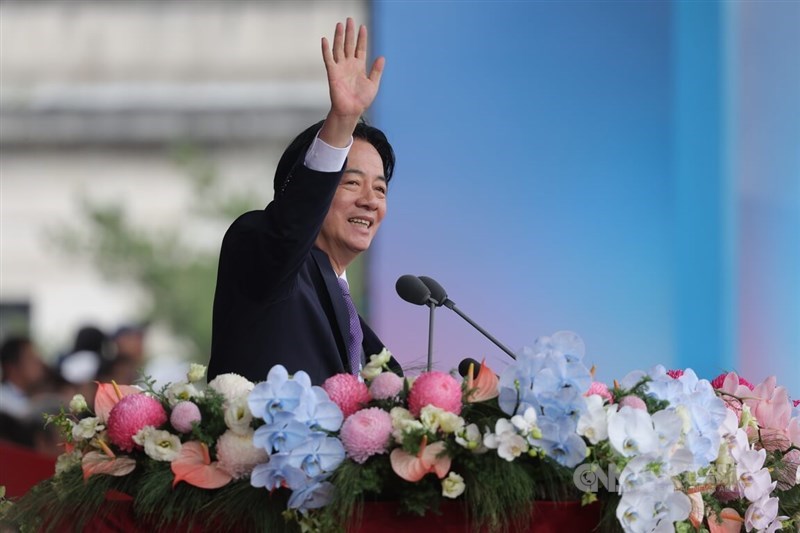
Taipei, Oct. 10 (CNA) President Lai Ching-te (賴清德) said on Saturday that Taiwan needed many industries across its economy to become a "chain of guardian mountains" to broaden the foundation of its economic strength.
In his National Day address outside the Presidential Office, Lai said leading companies expanding overseas should help their supply chains establish deeper roots in Taiwan.
"We cannot rely on just one guardian mountain; we must ensure that all sectors join together to form a chain of guardian mountains," Lai said.
His statement appeared to refer to Taiwan Semiconductor Manufacturing Co., the world's largest contract chipmaker and a pillar of Taiwan's economy. The United States, Japan and other countries have encouraged it to build factories abroad to strengthen supply security and reduce reliance on Taiwan.
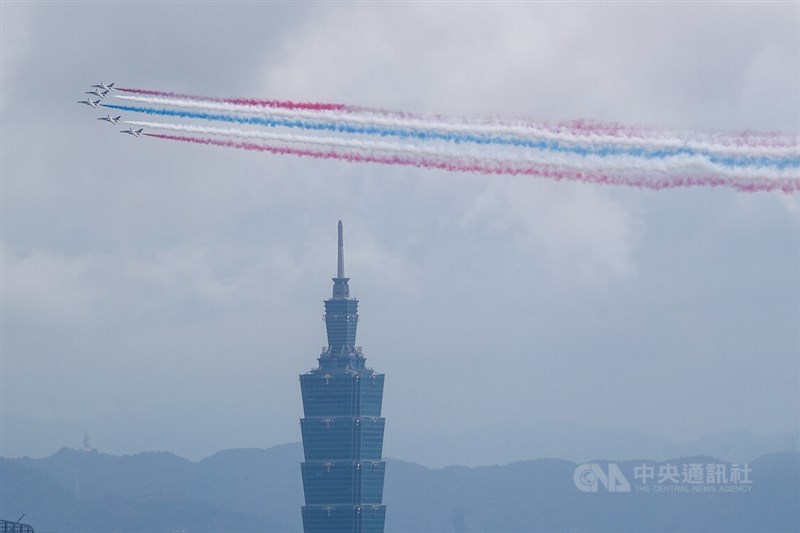
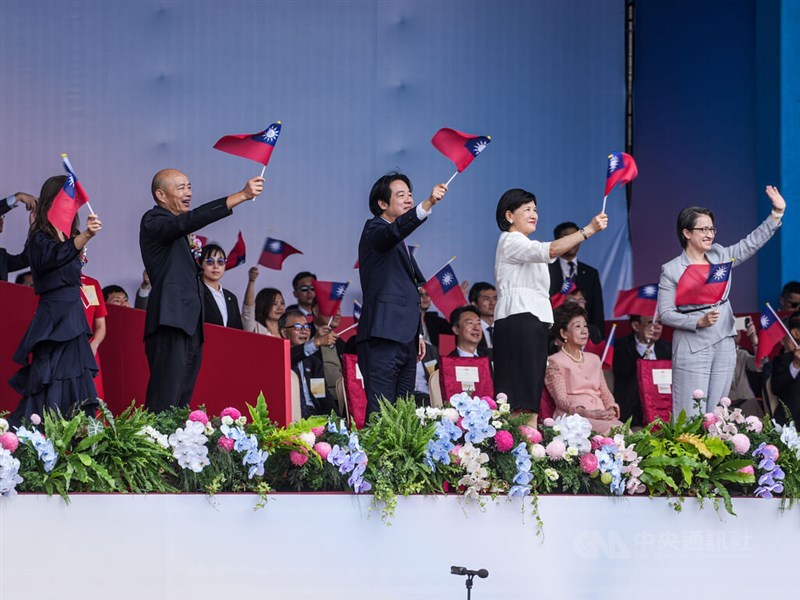
■ National Day celebrations kick off with parades, flyovers
■ National Day celebrations to showcase Taiwan's diversity, vitality: Speaker
Lai outlined government measures to support that development, highlighting Taiwan's strong economic performance while warning of challenges from tariffs, energy issues and competition from Chinese supply chains.
Taiwan's economy grew 14.15 percent in the first half of 2026, he noted. Full-year growth could exceed 11 percent, which would be the highest rate in 39 years, while per capita gross domestic product was projected to reach US$45,332, almost double its 2016 level.
The benchmark Taiex had reached 49,000 points, Lai said, with Taiwan's stock market becoming the world's fourth largest by market capitalization.
He also cited Taiwan's fourth-place finish in this year's World Competitiveness Ranking compiled by the Swiss-based Institute for Management Development, describing it as the country's best performance to date.
To sustain Taiwan's competitiveness, Lai said the Executive Yuan was accelerating the development of strategic industries and emerging technologies.
He highlighted the government's Five Trusted Industry Sectors -- semiconductors, artificial intelligence, defense, security and surveillance, and next-generation communications -- alongside the three core technologies targeted by its 10 new AI infrastructure initiatives: silicon photonics, quantum computing and robotics.
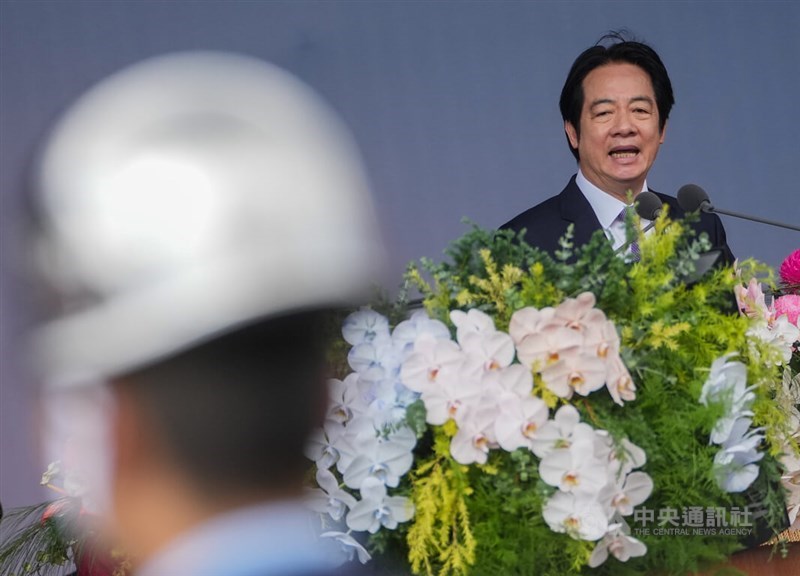
Technological advances should also benefit traditional industries, Lai said.
Other priorities include critical minerals, biotechnology and healthcare, an Asian asset management hub, public infrastructure and urban renewal, cultural and creative industries, and developing tourism into a trillion-NT-dollar industry.
A separate program for micro-, small- and medium-sized enterprises, with a scale of NT$100 billion (US$3.13 billion), would support financing, workforce training, digital transformation, net-zero upgrades and access to international distribution channels, Lai said.
To address labor and talent shortages, Lai said the government would maintain Taiwanese workers as the primary workforce, supplemented by workers recruited from overseas.
Measures include linking higher local wages to additional migrant worker quotas, easing retention restrictions on experienced migrant workers transitioning into skilled roles, and promoting direct government-to-government recruitment.
Amendments to the Act for the Recruitment and Employment of Foreign Professionals would also expand opportunities for international professionals to come to and remain in Taiwan and for foreign students to stay after graduation, he said.
On energy, Lai said the government would pursue stable electricity supply, energy security and a net-zero transition through renewable generation, storage, conservation and grid upgrades.
It would also pragmatically assess different energy options based on scientific evidence, legal procedures and safety standards, he said.
"We will not rule out options solely for ideological reasons, nor will we compromise the sustainability of future generations for short-term gains," he said.
Economic gains must also translate into better living standards, Lai said, citing 11 consecutive years of minimum wage increases, five pay raises for military personnel, civil servants and teachers over the past decade, and increases in professional and supervisory allowances this year.
He also outlined plans for a universal NT$10,000 cash payment and higher welfare benefits.
The goal, he said, was to ensure that prosperity was reflected not only in production and exports, but also in better pay and lighter burdens for families.
- Politics
Taiwan needs a 'chain of guardian mountains' across industries: Lai
10/10/2026 01:19 PM - Business
New ECCT chair urges greater agility in Taiwan's software, energy sectors
10/10/2026 12:36 PM - Culture
BigBang throws concert in Taipei; Jay Chou shares photos with group
10/10/2026 11:50 AM - Politics
Full text of President Lai Ching-te's National Day address
10/10/2026 11:10 AM - Society
Taiwan headline news
10/10/2026 10:08 AM