INTERVIEW/New ECCT chair urges greater agility in Taiwan's software, energy sectors
By Chao Yen-hsiang, CNA staff reporter
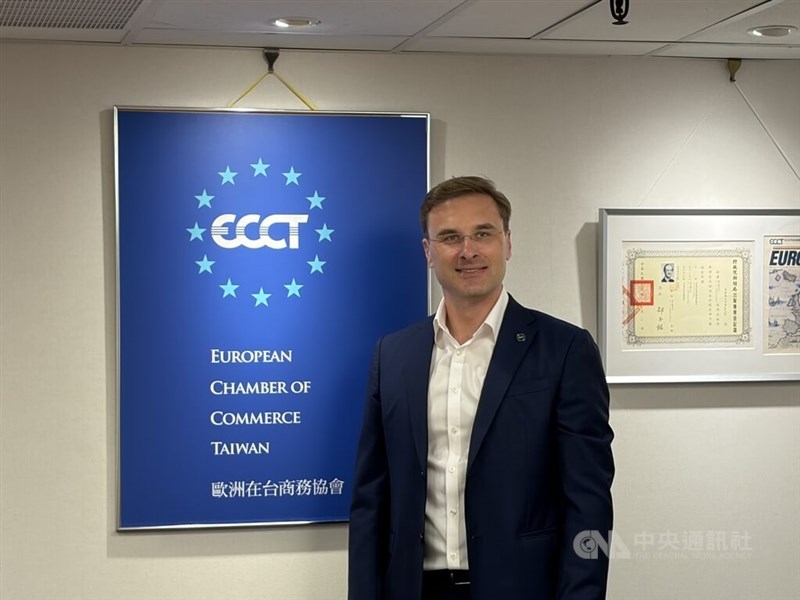
Taiwan is known for its strength in hardware manufacturing, but Frank Grunert, the new chairperson of the European Chamber of Commerce Taiwan (ECCT), sees considerable potential in software as well.
A hardware engineer typically starts with a defined product and works backward through the steps needed to build it, Grunert told CNA in an interview in Taipei on Monday.
"When you write software, you often don't know [what you'll have] in the end," he said. "You have a rough idea of what you want to have, but you have a lot of agile changes in between."
Software development also requires connecting information across sources and breaking down data silos, he said, describing the process as "a kind of co-creation with your customer, with your environment."
Grunert praised Taiwan's engineering precision and said he was impressed by its software startups. Agility is important to success in the software business, he added.
Grunert took over as chair of the ECCT on Sept. 1 after assuming leadership of Siemens Taiwan in August 2024. He previously served as Siemens' global head of grid control, a role involving software used to manage electricity networks.
Grunert also advocated a more agile approach to electricity infrastructure projects, saying Taiwan needs to expand power generation capacity and upgrade its grid to meet rapidly growing demand.
Once authorities identify the need for a substation, power plant or grid upgrade, budgeting and procurement must precede construction, he said. The entire process could take five to seven years.
"That is much too long," Grunert added.
He proposed dividing projects into smaller pieces and eliminating unnecessary administrative steps to accelerate implementation. Authorities should also be able to adjust budgets as circumstances change during construction, he said.
Public procurement could become more efficient through digitization, he added. Currently, companies bidding for large contracts still have to print extensive documentation and submit multiple copies.
In his inaugural message to ECCT members, Grunert identified energy supply and costs, labor and talent shortages, and deeper European-Taiwanese economic ties as issues that will shape business conditions into the next decade.
"Our chamber should think on that horizon, not only the next advocacy cycle," he wrote.
During the interview, Grunert said European equipment, chemicals and materials suppliers complement Taiwan's semiconductor industry. A bilateral investment agreement could provide businesses on both sides with a clearer framework and greater investment certainty.
On offshore wind, Grunert said canceled projects, slower development and companies withdrawing from the market were thinning the pipeline of new projects.
Overlapping or conflicting responsibilities between central and local authorities could delay permits, he said. For developers financing construction with bank loans, that can delay revenue while scheduled payments still have to be made.
He urged Taiwan to examine financing arrangements used elsewhere and improve permitting coordination to help developers and suppliers remain in the market.
Renewable power generation also strengthens resilience by reducing reliance on imported fuel, he said, while battery storage helps balance fluctuations in wind and solar power.
For electricity infrastructure more broadly, Grunert urged a change in how projects are implemented.
"We need to be able to slice projects in smaller pieces," he said.
Enditem/AW
![Strategic partnership key to Taiwan-U.K. cooperation: Deputy economics minister]() Strategic partnership key to Taiwan-U.K. cooperation: Deputy economics ministerTaiwan's Deputy Minister of Economic Affairs Cynthia Kiang (江文若), who has just concluded an annual economic and trade dialogue with her U.K. counterpart in London, said Friday that establishing a strategic partnership is key to bilateral cooperation.10/03/2026 01:53 PM
Strategic partnership key to Taiwan-U.K. cooperation: Deputy economics ministerTaiwan's Deputy Minister of Economic Affairs Cynthia Kiang (江文若), who has just concluded an annual economic and trade dialogue with her U.K. counterpart in London, said Friday that establishing a strategic partnership is key to bilateral cooperation.10/03/2026 01:53 PM![Taiwan, democracies must build resilience against China, Russia: Scholar]() Taiwan, democracies must build resilience against China, Russia: ScholarTaiwan and other democracies must strengthen their resilience against the "sharp power" wielded by authoritarian regimes such as China and Russia to defend their shared democratic values, a visiting American scholar said Monday.09/21/2026 04:39 PM
Taiwan, democracies must build resilience against China, Russia: ScholarTaiwan and other democracies must strengthen their resilience against the "sharp power" wielded by authoritarian regimes such as China and Russia to defend their shared democratic values, a visiting American scholar said Monday.09/21/2026 04:39 PM![European Parliament vice president praises Hsiao as 'role model' for women]() European Parliament vice president praises Hsiao as 'role model' for womenEuropean Parliament Vice President Pina Picierno on Saturday praised Taiwanese Vice President Hsiao Bi-khim (蕭美琴) as a role model for freedom-loving women around the world and told CNA that she would soon begin planning a trip to Taipei after accepting Hsiao's invitation to visit.09/13/2026 01:08 PM
European Parliament vice president praises Hsiao as 'role model' for womenEuropean Parliament Vice President Pina Picierno on Saturday praised Taiwanese Vice President Hsiao Bi-khim (蕭美琴) as a role model for freedom-loving women around the world and told CNA that she would soon begin planning a trip to Taipei after accepting Hsiao's invitation to visit.09/13/2026 01:08 PM

- Business
New ECCT chair urges greater agility in Taiwan's software, energy sectors
10/10/2026 12:36 PM - Culture
BigBang throws concert in Taipei; Jay Chou shares photos with group
10/10/2026 11:50 AM - Politics
Full text of President Lai Ching-te's National Day address
10/10/2026 11:10 AM - Society
Taiwan headline news
10/10/2026 10:08 AM - Society
National Day celebrations kick off with parades, flyovers
10/10/2026 09:10 AM