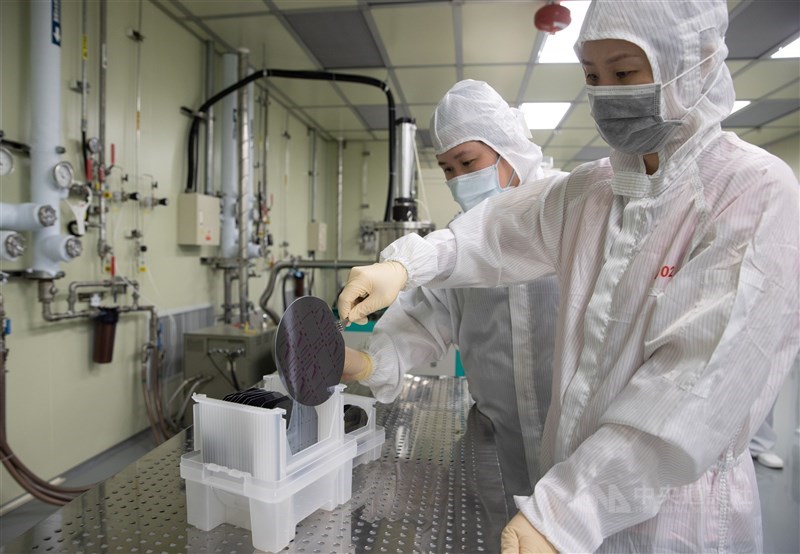
Taipei, Sept. 3 (CNA) Taiwan should avoid becoming overly dependent on semiconductors and preserve resources for other industries while expanding chip production with trusted overseas partners, a U.S. scholar said Thursday.
Glenn D. Tiffert, distinguished research fellow and co-chair of the Program on the U.S., China, and the World at Stanford University's Hoover Institution, made the remarks during a panel discussion on trusted supply chains at a forum hosted by the Research Institute for Democracy, Society and Emerging Technology (DSET) and SEMI in Taipei.
"The semiconductor industry has been fabulous for Taiwan, but there is the danger that Taiwan devotes too much to being the one-trick pony, as Detroit once did in the United States to automobiles," Tiffert said.
With Taiwan facing demographic pressures, the semiconductor industry is currently expanding faster than the country's supply of engineers, he observed.
Government policy could help diversify the economy and leave room for Taiwan to develop robotics, biotechnology and other industries, according to Tiffert.
At the same time, he argued, cooperation with Japan, Europe and the United States could distribute semiconductor production more widely without diminishing Taiwan's position.
Tiffert cited TSMC's Arizona operations as evidence, saying Taiwanese partners had helped the United States relearn manufacturing capabilities it had lost, adding that the fabs are also profitable, with yields comparable to those in Taiwan.
"This makes TSMC stronger. It makes Taiwan stronger. It makes the United States stronger together," he said.
The panel, moderated by DSET CEO Jeremy Chang (張智程), examined how countries with shared values can improve semiconductor supply chain resilience while preserving an international division of labor.
Instead of pursuing complete decoupling, governments should establish enough redundant capacity to withstand disasters, conflicts and other disruptions without attempting to replicate entire supply chains domestically, Tiffert argued.
Consumers would ultimately bear the additional cost, but such spending should be regarded as insurance against future disruptions, he added.
Emiko Higashi, a Kioxia board member and member of the Industrial Policy Council at Japan's Ministry of Economy, Trade and Industry, cautioned that government subsidies alone cannot make semiconductor projects viable.
"The company ultimately has to succeed on its own," Higashi said, referring to Japanese chipmaker Rapidus, which has received significant government support.
She cited Rapidus' collaboration with IBM on 2-nanometer technology as an example of allies combining U.S. research capabilities with Japanese manufacturing expertise.
Meanwhile, Marc Hijink, a financial reporter and technology columnist at Dutch newspaper NRC, warned that tighter restrictions on semiconductor equipment exports to China could create opportunities for Chinese competitors, particularly in less advanced lithography systems.
Europe remains strong in semiconductor research through organizations such as ASML and Imec but lacks sufficient chipmaking capacity, he noted.
Returning to the need for limited but coordinated redundancy, Tiffert said allies should maintain some domestic capacity while continuing to specialize in areas where they are strongest.
"I think that is sovereignty enhancing, actually, rather than sovereignty diminishing," he said.
- Business
Starlux adds fourth weekly Taipei-Prague flight
10/18/2026 09:08 PM - Society
Taichung Arena on track for completion in 2030: City gov't
10/18/2026 09:02 PM - Society
Typhoon Champi sea warning possible Wednesday night: CWA
10/18/2026 08:42 PM - Politics
Chiang touts first-term results; Shen denies cash gift rumors
10/18/2026 08:38 PM - Sports
Zeng Sheng-an's three-run homer gives Dragons 2-0 lead in Taiwan Series
10/18/2026 08:18 PM