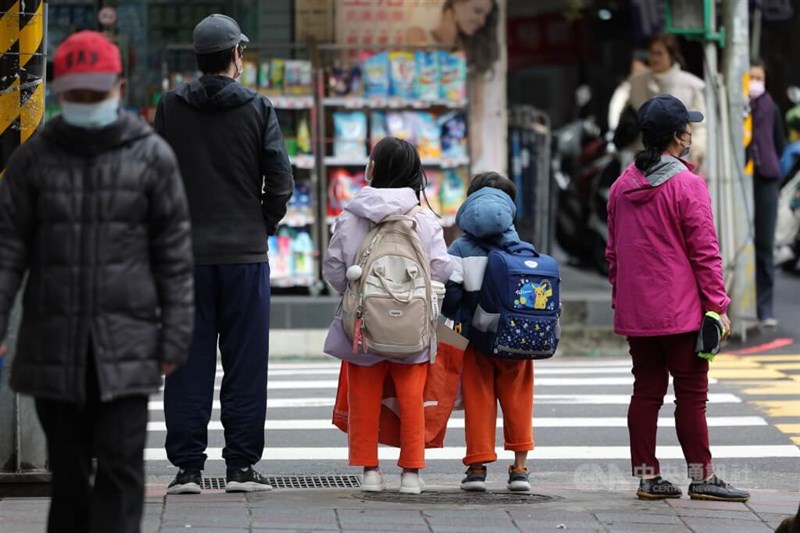
Taipei, March 24 (CNA) Nearly one in five schoolchildren in Taiwan show signs of social anxiety, according to a survey released Tuesday by the Child Welfare League Foundation (CWLF).
The survey found that 18.6 percent of children exhibit traits associated with social anxiety. Even among those who self-identified as extroverts, 11.2 percent met the criteria.
The foundation noted that some outwardly active children may be masking anxiety.
Children with social anxiety were significantly less likely to express themselves. Some 16.2 percent said they rarely interact with others in real life, compared with 8.2 percent of other children
Meanwhile, 18.3 percent said they are too nervous to express themselves online, versus 4.3 percent of their peers.
They were also less likely to defend themselves. Only 9.6 percent said they would stand up to online attacks, compared with 24.4 percent of those without anxiety. In real-life situations, 23.4 percent said they would stop name-calling, versus 35.5 percent of other children.
The survey found that 28.9 percent of socially anxious children would not tell anyone when facing difficulties. Many instead turn to online interactions, with 36.9 percent saying they feel more relaxed chatting with online friends.
Social anxiety also affects school engagement and health. About 17.3 percent of affected children reported not wanting to go to school, compared with 4.5 percent of others. Meanwhile, 63.9 percent reported sleep problems, with 11.9 percent experiencing them every night -- roughly twice the rate of other children.
Family and peer dynamics may be associated with the condition. Socially anxious children were more likely to report being scolded or questioned about schoolwork at home (18.4 percent versus 11.5 percent).
The CWLF said weakening peer support systems may also play a role, with 46.9 percent of all surveyed children seldom receiving comfort and 36.1 percent rarely receiving help.
The survey also pointed to declining social skills. About 38.3 percent of children said they do not know how to make friends, up from 23.3 percent in 2019, while 51.6 percent said they do not dare express their true opinions. Those unsure how to reconcile after conflicts rose to 56.9 percent from 42.4 percent.
Online behavior showed a contrast with real-life interactions. While 32.7 percent said they avoid conflict at school, 21.7 percent said they would directly confront others online. In addition, 29 percent said it is easier to talk to friends online than in person, and 42.5 percent said they interact more with classmates online.
The CWLF urged parents to provide emotional support and build trust with their children, while calling on schools to strengthen social and emotional education. It also encouraged the public to avoid labeling withdrawn children and to help build supportive environments.
The survey collected 1,255 valid responses from fifth- and sixth-grade students in Taiwan in September and October 2025. It had a 95 percent confidence level and a margin of error of plus or minus 2.76 percentage points.
Social anxiety was measured using self-reported responses based on the Social Anxiety Scale for Children-Revised (SASC-R).
- Sports
Taiwan-Australia duo Chan, Joint finish as Memphis runners-up
08/01/2026 08:33 PM - Society
THSRC plans biggest timetable overhaul, 'super express' trains by 2027
08/01/2026 08:26 PM - Sports
Taiwan's Tommy Chen crowned champion of 200k Mountain Ultra
08/01/2026 07:56 PM - Society
Second camellia oil maker suspended over carcinogen; source questioned
08/01/2026 07:38 PM - Business
CPC to leave domestic gasoline, diesel prices unchanged next week
08/01/2026 05:59 PM