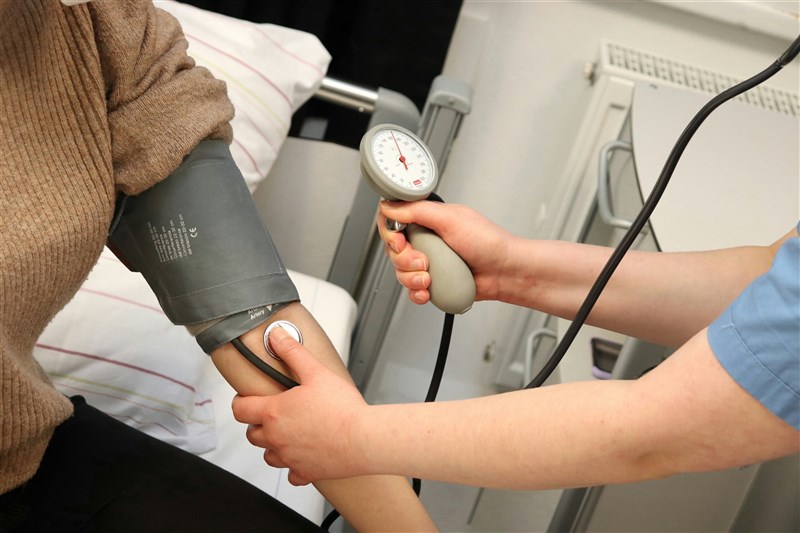
Taipei, May 8 (CNA) The Legislature on Friday mandated nurse-to-patient ratios in law, responding to long-standing calls to ease nurses' workloads, and stipulated that hospitals violating the regulation could be made to suspend operations for up to one year.
According to the amendment to the Medical Care Act passed by the Legislature, nurse-to-patient ratios will be first set at the target levels under a policy introduced by the Ministry of Health and Welfare (MOHW) in March 2024.
The ratios must be reviewed by the MOHW every three years, taking into account patients' interests and nurses' labor rights, and adjusted when necessary, according to the amendments which was proposed by the opposition Kuomintang (KMT) and backed by the smaller opposition Taiwan People's Party (TPP).
All three parties, including the ruling Democratic Progressive Party (DPP), supported making nurse-to-patient ratios a statutory requirement, but their proposals differed on the mechanism for determining the ratios.
The DPP proposed that the MOHW consult an advisory committee, with one-third of its members representing nurses, when determining the ratios, while the TPP's version stated that such representatives should make up no less than half of the total.
Each version received support only from lawmakers of the party that proposed it.

Outside the Legislature, several groups organized a protest after reports emerged that the proportion of nurses on an advisory committee could be lowered from one-half to one-third, as lawmakers held negotiations before the votes took place.
The negotiations then broke down, and lawmakers proceeded to vote on each version.
According to the MOHW's 2024 policy, the three-shift nurse-to-patient target ratios are set at 1:6 for day shifts, 1:9 for evening shifts, and 1:11 for night shifts at medical centers. For regional hospitals, the ratios are 1:7, 1:11, and 1:13 respectively, while for district hospitals they are 1:10, 1:13, and 1:15.
Hospitals that met that standard were eligible for incentive payments, but the ministry had no legal basis to impose penalties for noncompliance.
Following the amendments, hospitals violating the regulation will face fines ranging from NT$50,000 (US$1,594) to NT$250,000 for district hospitals, NT$200,000 to NT$1 million for regional hospitals, and NT$1 million to NT$2 million for medical centers.
Hospitals could also be ordered to suspend operations for up to one year if they are penalized three times without making sufficient improvements.
The MOHW introduced nurse-to-patient ratios in 2024, following longstanding calls from nurses to address excessive workloads and staffing shortages, a situation that many believed to have led nurses to leave their jobs.
According to TPP lawmaker Chiu Hui-ju (邱慧洳), Taiwan has about 300,000 licensed nurses, but only around 190,000 are currently in practice.
- Sports
Men's archery, esports give Taiwan 2 more bronzes at Asian Games
09/30/2026 08:32 PM - Society
Cooler, wetter weather forecast in northern Taiwan next week
09/30/2026 07:25 PM - Politics
Taiwan, Belize sign agreements to enhance collaboration during FM's visit
09/30/2026 07:08 PM - Society
AGC Display Glass employees protest at MOL ahead of 10/5 strike
09/30/2026 06:53 PM - Culture
CNA to relaunch Spanish-language Focus Taiwan with AI assistance
09/30/2026 05:59 PM