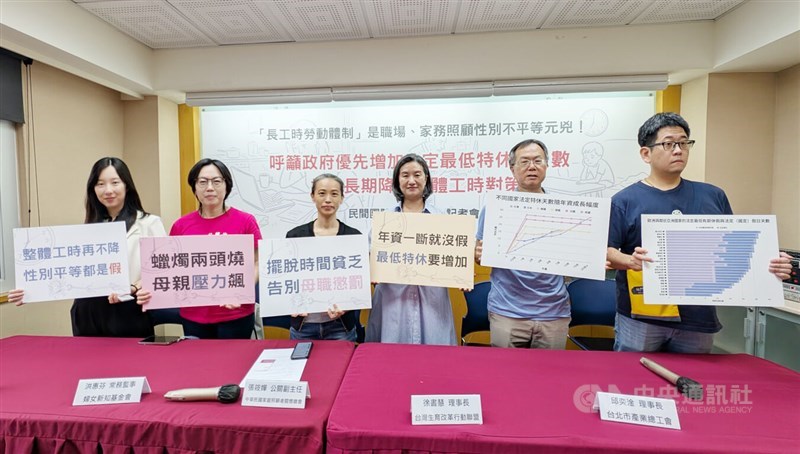
Taipei, May 8 (CNA) Civil group representatives on Friday called for an increase in paid annual leave days and for it to be decoupled from seniority, saying the change would help ease the family care burden that often falls disproportionately on women.
The government should amend the Labor Standards Act to substantially increase the number of paid annual leave days, which are currently based solely on length of service, said Kuo Yi-ching (郭怡青), chairperson of the Awakening Foundation.
It is imperative that the government help share the responsibility of taking care of children "between both parents" and "between the state and families," instead of placing the duty primarily on mothers, Kuo said at a news conference.
Kuo, along with representatives from Taiwan Labour Front and other civil groups, held the event on the eve of Mother's Day on Sunday, highlighting "long working hours as a key driver of gender inequality in household and care work."
Women in Taiwan spend an average of 3.03 hours a day on household and care work, rising to 4.41 hours for married women -- about 2.6 times more than their husbands, said Hung Hui-fen (洪惠芬), a professor in Soochow University's Department of Social Work.
Meanwhile, female employees in Taiwan work an average of 165.7 hours a month, compared to 170.5 hours for male employees, Hung said.
The data suggests women are more likely to work part-time or take leave, as they more often need to step away from work to meet family responsibilities, Hung added.
Under the Labor Standards Act, employees are entitled to three days of paid annual leave after working at a company for more than six months but less than one year.
Employees are granted seven days of paid annual leave after one year of service, 10 days after two years, 14 days for three to five years, 15 days for five to 10 years, with one additional day added annually beyond 10 years, up to a maximum of 30 days.
Yang Shu-wei (楊書瑋), secretary-general of the Taiwan Labour Front, said that the law linking paid annual leave to length of service is "unreasonable" and "out of step with current conditions," where young workers change jobs every two to three years.
The system means that only those who stay at a company for more than 25 years can reach the maximum of 30 days of annual paid leave, he said, adding that Taiwan's law compares poorly with the significantly more generous statutory leave systems in countries such as South Korea, Germany, France and the United Kingdom.
Long working hours undermined gender equality, as they disproportionately force female employees to take time off work to fulfill family caregiving responsibilities, Yang said.
- Society
DPP township council candidate dies after collapsing on stage
09/23/2026 11:52 AM - Science & Tech
Taiwan part of WorldSkills Competition opening ceremony in China
09/23/2026 10:53 AM - Business
U.S. dollar down in Taipei trading
09/23/2026 10:17 AM - Society
Taiwan headline news
09/23/2026 10:05 AM - Business
Taiwan shares open higher
09/23/2026 09:15 AM