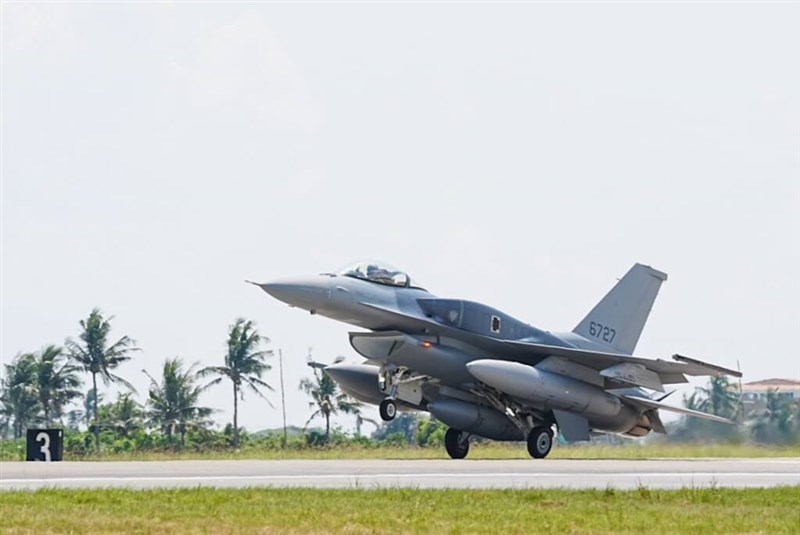
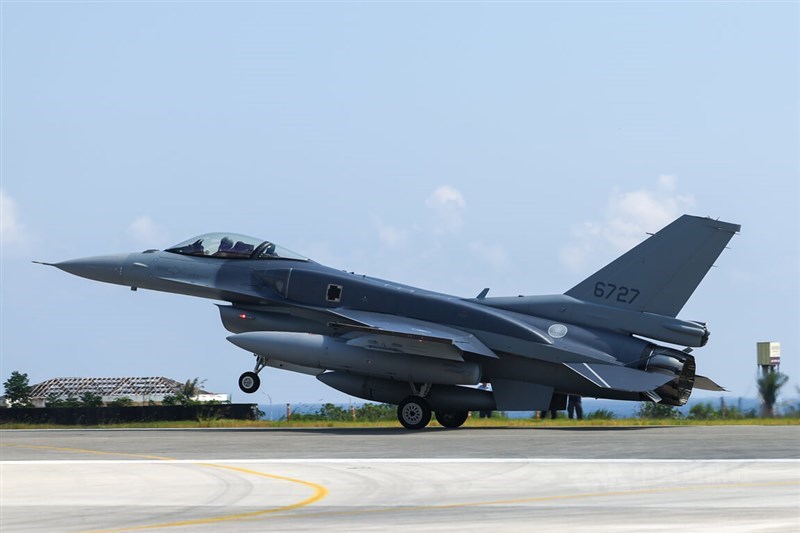
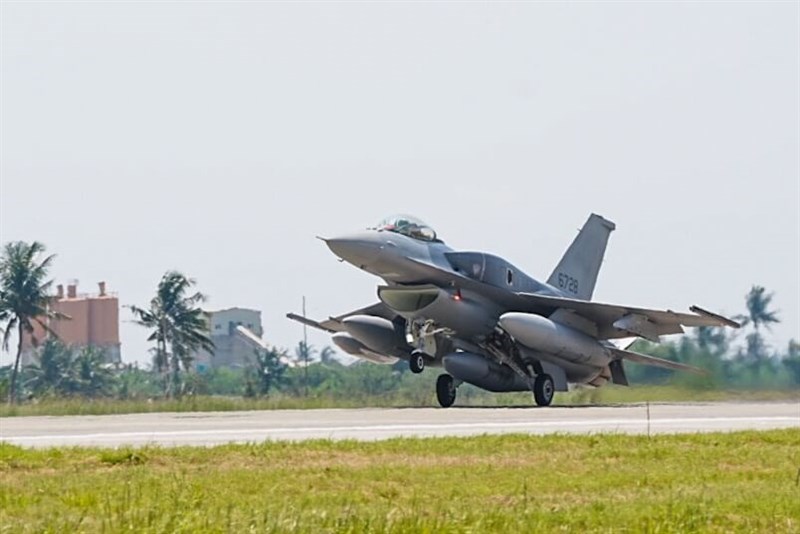
Taipei, Oct. 2 (CNA) Taiwan took delivery of the first two of the 66 F-16V Block 70 fighter jets Taiwan purchased from the United States after they arrived at an eastern Taitung County air base Friday.
The aircraft landed at Chihhang Air Base in the eastern county of Taitung around noon.
The long-awaited arrival marks the latest milestone in U.S.-Taiwan defense cooperation.
The two jets are part of the Taiwan Air Force's "Peace Phoenix Soaring" project, under which the government spent NT$247.2 billion (approximately US$8 billion) between 2020 and 2026 to procure 66 new F-16V Block 70 fighter jets.
The 66 jets were originally scheduled to be delivered to Taiwan in batches by the end of this year, but the program was delayed by several factors, including the relocation and restart of the production line and disruptions to the supply chain.
The CNA has prepared a breakdown of the purchase history of the jets and what their addition means for Taiwan's defense capabilities.
1. From F-35B to F-16V
In August 2019, the U.S. State Department approved a Foreign Military Sale (FMS) of 66 new Lockheed Martin F-16C/D Block 70 (F-16V) fighter jets to Taiwan, valued at an estimated US$8 billion.
It was the first major defense equipment sale approved by Washington for Taipei following the passage of the John S. McCain National Defense Authorization Act for Fiscal Year 2019 and the Taiwan Assurance Act of 2019.
Both laws reaffirmed U.S. support for Taiwan's self-defense capabilities and its vital role as a key partner in the U.S. Indo-Pacific strategy.
The decision to buy F-16Vs came after Taiwan abandoned its earlier pursuit of the more advanced F-35B, a short takeoff and vertical landing fighter, due in part to its high procurement and maintenance costs.
After considering logistical continuity and the expectation that Taiwanese pilots would be able to transition smoothly to the new aircraft given they are already familiar with Taiwan's existing F-16 fleet, Taiwan decided to purchase F-16Vs instead.
2. Meeting Taiwan's defense needs as Taitung air base transitions
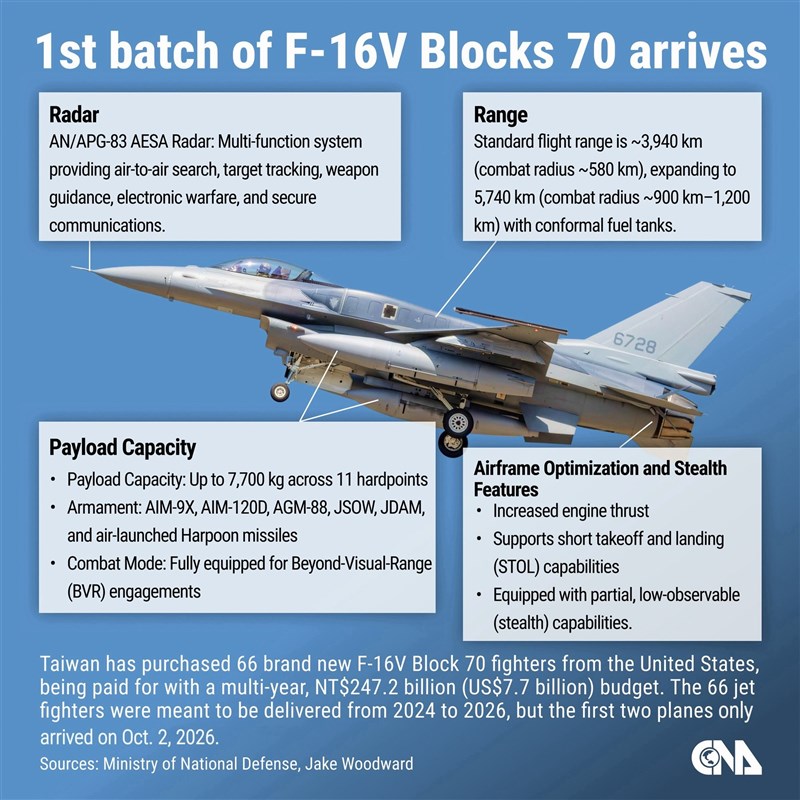
The F-16V Block 70 pairs the Northrop Grumman AN/APG-83 active electronically scanned array (AESA) radar with the L3Harris AN/ALQ-254(V)1 Viper Shield electronic warfare suite.
The jet is powered by a General Electric F110-GE-129 turbofan engine capable of delivering up to 29,500 pounds of thrust, while its conformal fuel tanks (CFTs) can significantly extend its operational range and loiter time.
Pilots are also equipped with the Joint Helmet Mounted Cueing System II (JHMCS II), which allows them to aim weapons and cue sensors by looking at a target.
Together, these systems are expected to significantly enhance the fighter's beyond-visual-range engagement and multi-target strike capabilities, including in an environment subject to electromagnetic interference.
After arriving in Taiwan, the F-16V Block 70s are to be stationed at Taitung's Chihhang Air Base.
Their deployment is expected to reinforce air defense capabilities in the eastern Hualien-Taitung area and help counter potential Chinese naval and aerial maneuvers aimed at encircling Taiwan.
The eastern air base, which was previously home to the now-decommissioned F-5E/F fleet, primarily used for training purposes, will now become a main combat unit.
3. Economic benefits and F-16 maintenance center
With the addition of all 66 F-16V Block 70s to Taiwan's existing fleet of 139 upgraded F-16A/Bs, Taiwan will operate one of the world's largest fleets of F-16V aircraft.
Taiwan also helped fund the development of the F-16V upgrade program and, after other countries withdrew, became its sole investor.
The F-16V has since gained popularity internationally, with Taiwan receiving royalties when other countries purchase new F-16V aircraft or upgrade their older F-16s, according to an unnamed military official.
As of the end of 2025, Taiwan had received more than US$70 million in royalties from the development of the F-16V, as countries around the world purchased or upgraded aircraft to the model, the official said.
Taichung-based Aerospace Industrial Development Corp. (AIDC) also operates a maintenance center for F-16 fighter jets, which is expected to service aircraft operated by countries throughout the region.
The development of domestic defense industry capabilities, including those of AIDC, can not only reduce operating and maintenance costs but also strengthen Taiwan's ability to rapidly repair battle damage during wartime.
4. Boosting long-range strike capabilities
The F-16V Block 70 features heavyweight landing gear designed to support increased maximum takeoff weights and heavier weapons payloads. It also has 11 external hardpoints, or weapon stations, for carrying fuel tanks and ordnance.
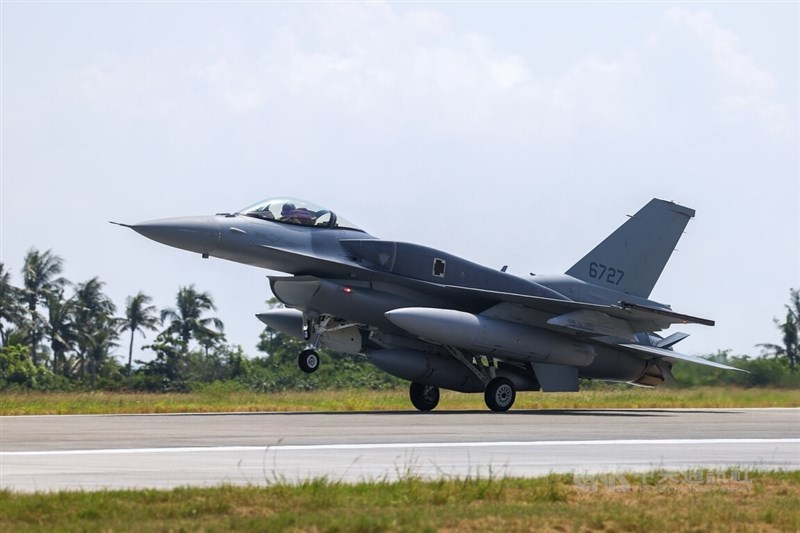
The fighter can be armed with a range of air-to-air and air-to-surface weapons, including AIM-9X and AIM-120D air-to-air missiles, as well as AGM-88 and AGM-154C missiles, JDAM precision-guided munitions and Harpoon anti-ship missiles.
Its increased weapons and fuel-carrying capacity can extend the F-16V's combat radius, potentially allowing Taiwan's Air Force to conduct missions beyond traditional air-defense interception, including strikes against Chinese coastal radar facilities and maritime targets.
- Politics
A breakdown of Taiwan's F-16V purchase, as first two jets arrive
10/02/2026 12:39 PM - Politics
F-16Vs vital for Taiwan despite rise of drones: Experts
10/02/2026 12:39 PM - Politics
Taiwan receives first 2 F-16V Block 70s
10/02/2026 12:13 PM - Politics
Military stages full-scale National Day flyover rehearsal in Taipei
10/02/2026 11:24 AM - Society
Taiwan headline news
10/02/2026 10:48 AM