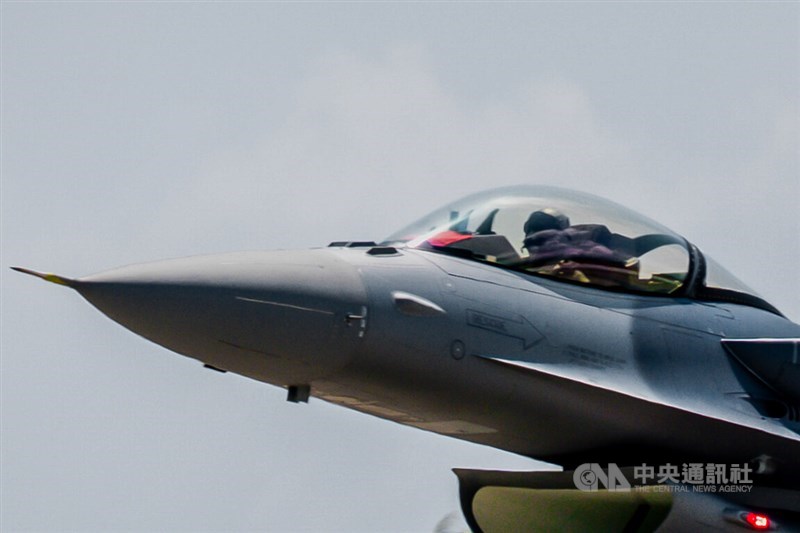
Taipei, Oct. 2 (CNA) F-16C/D Block 70 fighter jets remain relevant in modern warfare even as drones are playing an increasingly prominent role, an expert told CNA, citing their ability to conduct combat air patrols (CAPs) and threaten conventional surface warships, including Chinese aircraft carriers deployed in waters off Taiwan's east coast.
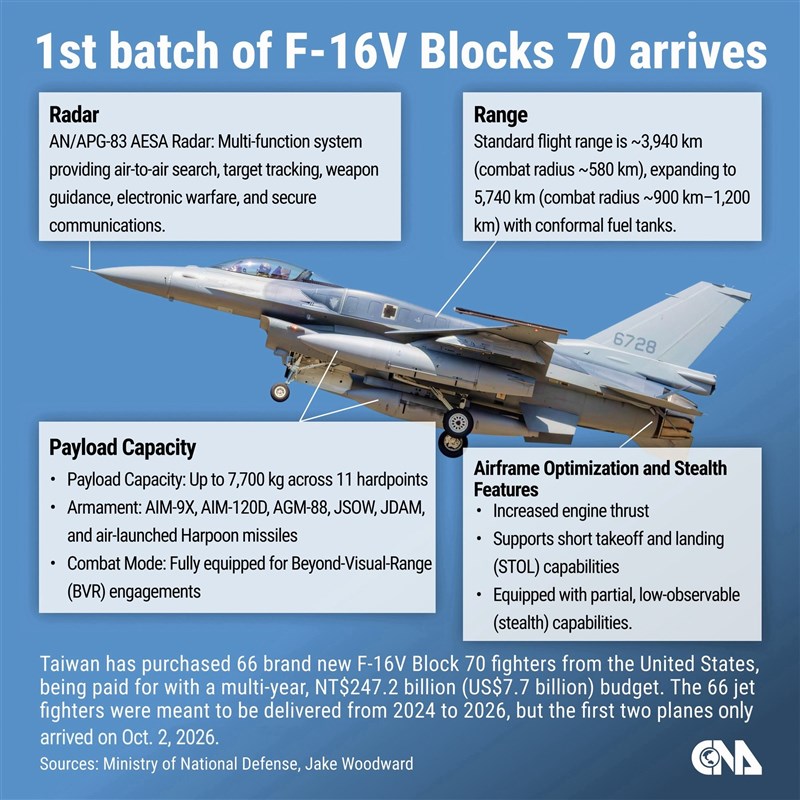
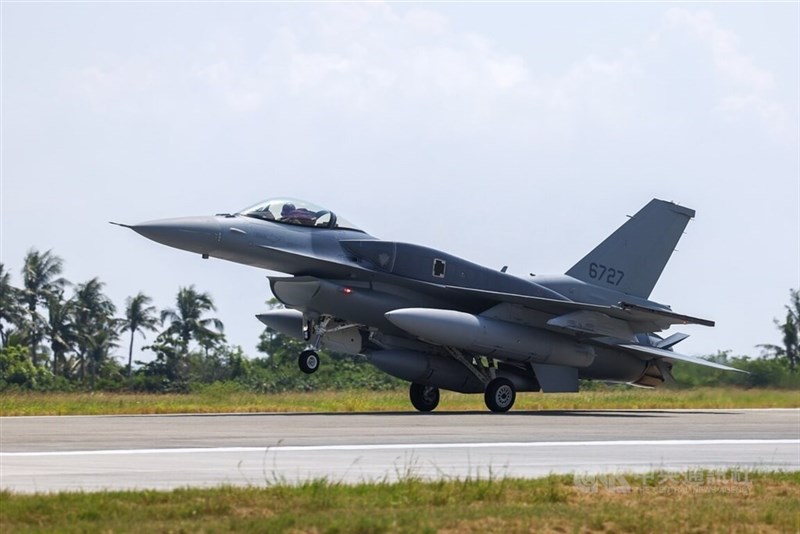
Taiwan received the first two of the 66 F-16 C/D Block 70 (also known as F-16V Block 70) jets it ordered from the United States in 2019 on Friday. Although the full order was supposed to be delivered by the end of the year, that target will not be met due to supply chain disruptions, among other issues.
During wartime, Chinese forces would try to damage runways at Taiwan's airbases to prevent its fighter jets from taking off, said Shu Hsiao-huang (舒孝煌), an associate research fellow at Taiwan's government-funded Institute for National Defense and Security Research.

While airbases in eastern Taiwan would be less likely to be targeted by Chinese ballistic missiles or long-range rockets, they would nonetheless be vulnerable to ship-to-surface and air-to-surface weapons, Shu said.
In addition, China could deploy one of its aircraft carriers and other large surface vessels further away from Taiwan's east coast to evade coastal missiles and threaten shipping routes used to transport weapons, gas and fuel, Shu said.
The need to defend against those threats, Shu noted, is why drones could not replace conventional fighter jets such as the F-16C/D Block 70s.
Drones cannot be deployed as effectively against large surface vessels, such as aircraft carriers, due to their limited payload capacity, he said.
Furthermore, the ability of drones to detect and track airborne targets is not as extensive as those of fighter jets, which provide more effective deterrence against airborne threats, Shu added.
"The ability of fighter jets to conduct CAPs, generally speaking, cannot yet be replaced," he said.
Even in the Russia-Ukraine war, known for its extensive use of drones, Ukraine has dispatched MiG-29 fighter jets to engage Russian fighters and drones, in part due to its dwindling supply of surface-to-air missiles as the fighting has continued, Shu added.
Shu referenced an online video clip uploaded on Aug. 21 in which a Ukrainian MiG-29 fighter jet was seen pursuing a Russian Shahed drone at close range before the drone suddenly nosedived.
Shu said the Shahed could have been affected by the MiG-29's wake turbulence and that, if true, the encounter might have demonstrated a "zero-cost" counter-UAV tactic.
Meanwhile, Cathy Fang (方怡然), a policy analyst at Taiwan's government-funded Research Institute for Democracy, Society and Emerging Technology (DSET), said that drones are meant to complement conventional fighter jets, not replace them.

"The value (of drones) is not that they replace conventional systems. It is that they add larger numbers of dispersed, lower-cost, and more replaceable sensors and shooters, increasing the density and resilience of Taiwan's existing defense architecture," Fang said.
Limitations and path to upgrading
Despite the F-16V Block 70's larger fuel capacity, which allows the jets to remain airborne for longer periods, and their ability to carry more missiles, Shu highlighted a major limitation should they encounter China's fifth-generation stealth fighter jets, such as the J-20.
"They are not easily spotted, but they can see us," Shu said.
The threat becomes more serious if enemy stealth fighters are equipped with beyond-visual-range missiles such as the PL-15 or PL-17, Shu said.
One system that could help overcome this capability gap is the Legion-ES IRST21, also known as the Legion Pod, developed by Lockheed Martin and capable of being integrated with F-16s, he said.
The pod uses infrared search and track (IRST) technology to detect and track the thermal signatures of stealth fighter jets without activating radar, and can support targeting for weapons such as AIM-120 Advanced Medium-Range Air-to-Air Missiles (AMRAAM).
"The enemy would not easily detect that we are monitoring it or firing weapons at it," Shu said. "This way, we could ambush the adversary and pose a substantial threat to enemy warplanes."
While Lockheed Martin does not publicly disclose the Legion Pod's detection range, the sensor system is designed to detect and track airborne targets at extended ranges, with its effective range depending on factors such as the target's thermal signature and environmental conditions.
Taiwan has agreed to purchase 55 Legion Pods for use by its F-16 fleet. The U.S. Department of State approved the sale in August 2023, and the systems are scheduled to be delivered in full by June 2031.
- Politics
A breakdown of Taiwan's F-16V purchase, as first two jets arrive
10/02/2026 12:39 PM - Politics
F-16Vs vital for Taiwan despite rise of drones: Experts
10/02/2026 12:39 PM - Politics
Taiwan receives first 2 F-16V Block 70s
10/02/2026 12:13 PM - Politics
Military stages full-scale National Day flyover rehearsal in Taipei
10/02/2026 11:24 AM - Society
Taiwan headline news
10/02/2026 10:48 AM