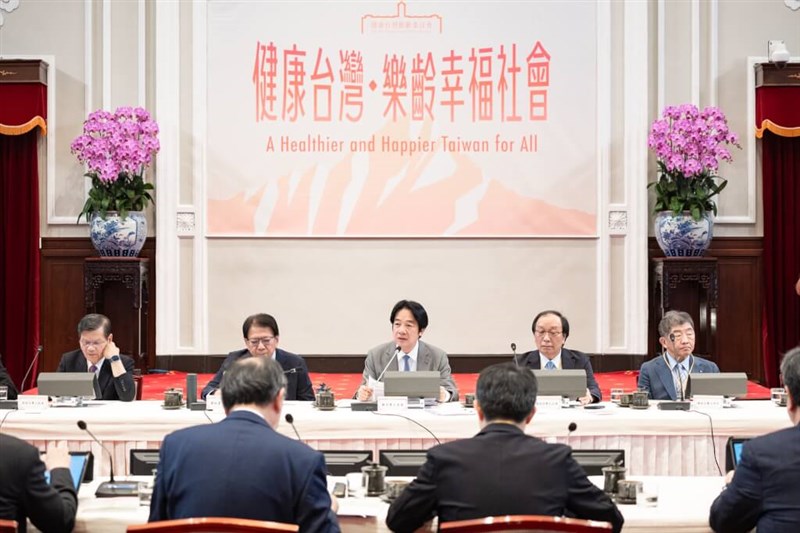
Taipei, Aug. 28 (CNA) Taiwan will launch its "health tokens" incentive program in October, rewarding adults for undergoing health checks and cancer screenings as part of a broader push to promote preventive care, President Lai Ching-te (賴清德) said Thursday.
"Taiwan has entered a super-aged society, and chronic diseases have become a major challenge to public health," Lai said in opening remarks at a meeting of the Presidential Office's Healthy Taiwan Promotion Committee.
Lai, who serves as convener of the committee, said Taiwan's health policy "must gradually shift" from disease treatment toward health promotion and preventive medicine.
To achieve that goal, Lai said the Ministry of Health and Welfare will launch the "health tokens" program in October, using incentives to encourage people to "proactively undergo health checks and cancer screenings, make use of preventive care, and manage their health."
In response to a CNA inquiry, the Health Promotion Administration (HPA) said Friday that the program will initially be open only to Taiwanese nationals aged 18 and above.
The agency said the restriction reflects the fact that the program is being introduced for the first time and will initially focus on Taiwanese adults.
It added that eligibility could later be expanded, as has been the case with government-funded cancer screening programs, which have gradually been extended to foreign nationals covered by the National Health Insurance (NHI) system.
In her presentation at Thursday's meeting, HPA Director-General Shen Ching-fen (沈靜芬) said seven of Taiwan's 10 leading causes of death are related to chronic diseases, while cancer has remained the country's leading cause of death for 44 consecutive years.
Although the government already provides free health checks and screenings for certain cancers, participation remains relatively low, Shen said, noting that uptake has hovered at around 30 to 50 percent in recent years.
"The problem is not that the services provided are insufficient," she said. "People often know they should do it, but don't," citing busy schedules, feeling healthy and a lack of immediate motivation as reasons.
The health tokens program is therefore intended to provide a "positive incentive" to turn health awareness into action and boost participation in preventive services, Shen said.
Under the first phase outlined in Shen's presentation, participants will earn tokens for completing designated health activities, with the number awarded varying according to their expected health benefits.
For example, a health check will earn 800 tokens, while breast, oral and lung cancer screenings will each earn 1,000 tokens.
Colorectal cancer screening will earn 900 tokens, or 1,350 if a colonoscopy is performed.
A flu vaccination will earn 450 tokens, while completing a lifestyle questionnaire will earn another 100 tokens.
Participants will be able to redeem their tokens after accumulating at least 1,000.
HPA estimates show that some participants could accumulate as many as 13,150 tokens during the two-year validity period, depending on their age, sex and risk factors such as smoking.
The tokens will be redeemable for "health-oriented" food products at participating convenience stores and hypermarkets, although Shen did not specify what types of products would qualify.
- Science & Tech
ITRI showcases cultural technology at Kaohsiung expo
10/13/2026 06:00 PM - Business
U.S. dollar tops NT$32 amid escalating geopolitical concerns
10/13/2026 05:34 PM - Politics
One Taiwanese injured in attack on Saudi Arabia airport: MOFA
10/13/2026 04:54 PM - Sports
Taiwan's Chuang, Liu win gold, silver at World Skate Games in Paraguay
10/13/2026 04:46 PM - Business
Taiex plunges 960 points as tech stocks hit by heavy U.S. losses
10/13/2026 04:31 PM