Taiwan has 3-5 year window to build non-China robot supply chain: DSET
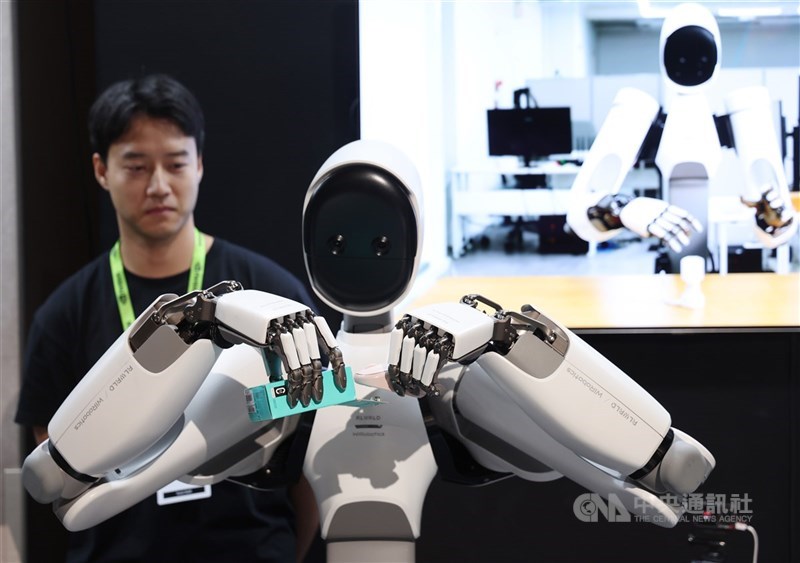
Taipei, Aug. 18 (CNA) Taiwan and other technology democracies have a "golden but narrowing" three-to-five-year window to lay the foundations for an advanced robotics supply chain outside China, particularly for humanoid robots, a Taiwan-based researcher said Tuesday.
A report released Monday by the Research Institute for Democracy, Society and Emerging Technology (DSET) examines China-West competition in physical artificial intelligence (AI) and Taiwan's potential role in developing alternatives to Chinese robot supply chains.
Humanoid robots remain unproven, meaning China's lead in shipments currently has a limited impact on the real economy, Nathanael Cheng (鄭秉信), a policy analyst in the DSET Economic Security Program, said in a written response to CNA.
Chinese vendors accounted for 85 percent of global shipments of humanoid and quadruped robots in 2025, according to Smart Analytics Global, a market research firm cited in the DSET report, although only around 10 percent of humanoid robots were deployed in real-world applications.
Nevertheless, China has developed a relatively mature supply chain and is competing effectively with Western companies, Cheng said.
"There is a golden but narrowing window of opportunity in the next 3-5 years for techno-democracies to lay the groundwork and make the right investments for non-red robot manufacturing and deployment," he said, using a term referring to supply chains that exclude China.
Cheng cited the U.S. Federal Communications Commission's (FCC) recent addition of certain foreign-produced advanced robots to its Covered List as an example of how policy can create market incentives.
The designation prevents new covered equipment containing radio-frequency components from receiving FCC authorization, effectively barring it from being imported or sold in the United States.
The DSET report, titled "The Age of Robotics: China-West Competition and Taiwan's Indispensable Role in the Non-Red Supply Chain," said China's manufacturing base and deployment scale could give it an advantage in collecting operational data.
Unlike in drones and electric vehicles, however, China has yet to dominate the physical AI technology stack and remains dependent on U.S. frontier edge AI chips and simulation software, as well as Japanese and European precision machinery and components, it said.
Meanwhile, companies from technology democracies retain an edge in traditional industrial robotics where reliability and precision are critical, Cheng said, noting that the U.S. imports over two-thirds of its industrial robots from Germany and Japan.
DSET identified around 180 Taiwanese entities involved in, or developing capabilities related to, the robotics supply chain.
The report said Taiwan's potential stems from three strengths: electronics manufacturing services companies capable of integrating and scaling complex systems, a precision component ecosystem, and advanced semiconductor manufacturing led by Taiwan Semiconductor Manufacturing Co.
The main obstacles are limited awareness among U.S. startups of what Taiwan can offer and the fact that most American robotics companies have yet to begin mass production, Cheng said.
Some Taiwanese component makers have established supplier relationships with U.S. companies, but others are awaiting stronger policy support and demand signals before investing further, he said.
Cheng urged the U.S. and Taiwanese governments to convene bilateral discussions on physical AI and offer incentives where normal market mechanisms are insufficient.
Sunny Cheung (張崑陽), a DSET global fellow, said in a separate written response to CNA Tuesday that efforts to develop a non-China supply chain should be phased and targeted.
The priority should be to exclude Chinese-made software, sensors, chips, controllers and firmware to eliminate cybersecurity and data-transfer risks, he said.
Lower-risk components such as screws and gears could be addressed later, while reducing reliance on China for motors would be difficult in the near term because of its dominance in rare-earth magnets, Cheung added.
Meanwhile, Taiwanese component sales to China are declining as domestic Chinese suppliers expand, Cheung said.
"Taiwanese companies need to pivot to other markets not just to survive, but to thrive," he said.
That shift could create opportunities for companies able to meet U.S. cybersecurity standards and certification requirements to become trusted suppliers, Cheung added.
- Society
Seasonal winds to bring cooler weather across parts of Taiwan
10/03/2026 07:26 PM - Politics
Local election campaigns heat up across Taiwan
10/03/2026 06:56 PM - Politics
Taiwan confirms its patrol vessels monitoring Chinese ships near Philippines
10/03/2026 06:46 PM - Business
CPC to leave domestic gasoline, diesel prices unchanged next week
10/03/2026 05:48 PM - Science & Tech
Taiwan, U.K. sign science, technology deal covering 3 areas
10/03/2026 04:26 PM