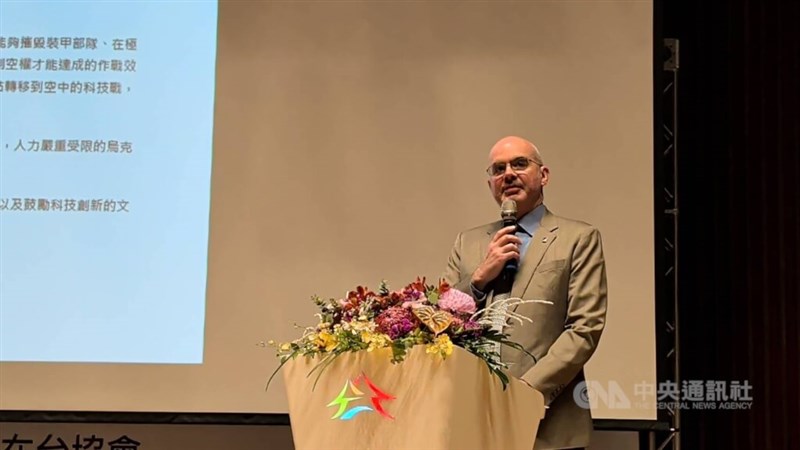
Taipei, July 8 (CNA) The American Institute in Taiwan (AIT) said Wednesday that the United States' policy on Taiwan has not changed, responding to Chinese criticism of recent remarks by AIT Director Raymond Greene on Taiwan's drone development.
Speaking at a drone industry forum in Taichung on July 2, Greene described drones as a "game-changing opportunity" to strengthen Taiwan's security and reinforce peace across the Indo-Pacific.
The de facto U.S. ambassador also said that "turning Taiwan into a hornet's nest of air, surface and subsurface drones" would help deter conflict, adding that the U.S.is ready to partner with Taipei to achieve that vision.
• Drone cooperation a 'game-changer' for Taiwan's security: U.S. envoy
In response, China's Taiwan Affairs Office (TAO) spokesperson Chen Binhua (陳斌華) criticized Greene on Wednesday for his recent comments on Taiwan-related issues, accusing him of promoting fallacies such as "dialogue without preconditions," pressuring Taiwan to pass a special defense budget, and stoking tensions across the Taiwan Strait.
Chen also claimed U.S. President Donald Trump has publicly said he does not want Taiwan to "go independent" and would not hastily approve arms sales to Taiwan. Greene's remarks, Chen said, ran counter to Trump's "serious stance" and risked steering U.S.-China relations in a "dangerous direction."
He urged relevant U.S. agencies to stop making what he described as "incorrect remarks" and to stop sending "false signals" to what Beijing calls "Taiwan independence separatist forces."
Responding to a request for comment from CNA, an AIT spokesperson said the U.S. "strong commitment to Taiwan endures" and that U.S. policy remains unchanged, guided by the Taiwan Relations Act, the three U.S.-China joint communiqués and the Six Assurances.
The spokesperson also cited remarks by U.S. Secretary of State Marco Rubio on June 2 that the U.S. "wants to see the status quo preserved as is," reiterating that Washington's Taiwan policy has not changed.
"The long-standing U.S. position is that Beijing should engage with Taiwan's elected leaders without preconditions," the spokesperson said.
Wang Hung-jen (王宏仁), a professor in the Department of Political Science at National Cheng Kung University, told CNA that Greene's remarks were "sensitive" from Beijing's perspective because they could be interpreted as signaling U.S. support for Taiwan's military development.
However, Wang said Beijing had "overreacted," arguing that Greene's attendance at the forum was a normal part of U.S.-Taiwan exchanges.
He said Beijing's strong response reflected its concern that Taiwan's drone industry has reached a certain level of maturity, raising the prospect of deeper U.S.-Taiwan cooperation in the sector.
Beijing is also unhappy to see Greene publicly endorse the message that Taiwan has made progress in strengthening its self-defense capabilities, Wang said.
Through the TAO's criticism, Beijing is essentially telling the U.S. that it is watching closely, he said.
Meanwhile, Hung Yao-nan (洪耀南), deputy director of Tamkang University's Institute of China Studies, told CNA that Beijing opposes Taiwan's efforts to develop its own defense capabilities, making any public comments by the AIT on the subject particularly sensitive.
Hung noted that while Beijing's criticism was ostensibly aimed at the U.S., its primary objective was to issue a warning to Taiwan.
Hung added that regardless of any statements made by the AIT, developing self-defense capabilities remains a fundamental necessity and the correct strategic direction for Taiwan.
- Business
Taiwan shares open higher
10/02/2026 09:08 AM - Business
Taiwan's manufacturing activity expands at fastest pace in 5 years
10/01/2026 09:12 PM - Culture
Drama film 'Arrested Memory' leads 11 Golden Horse nominations
10/01/2026 09:09 PM - Politics
- Sports
Taiwan's medal standing at 2026 Aichi-Nagoya Asian Games
10/01/2026 08:46 PM