Taiwan's political institutions 'failing' under divided government: U.S. scholar
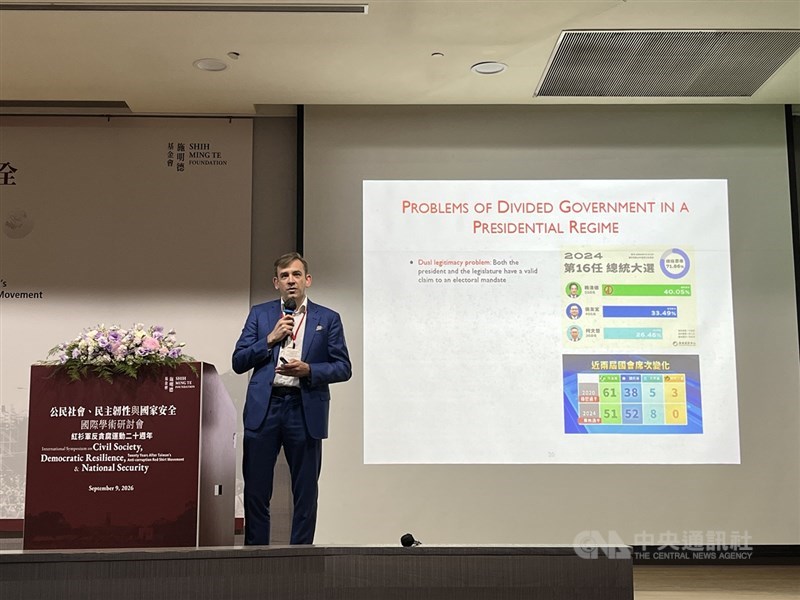
Taipei, Sept. 10 (CNA) Taiwan's current political deadlock reflects institutional weaknesses that were largely obscured during years of unified government, a U.S. scholar said Wednesday at a symposium in Taipei.
Kharis Templeman, a research fellow at the Hoover Institution at Stanford University, argued that Taiwan's current political difficulties are largely institutional, rather than the result of partisan polarization, Chinese interference or parts of the political system rejecting liberal democratic principles.
"Taiwan's constitutional framework is being tested for the first time now, and I think it's fair to say it's not scoring well," Templeman said in his speech. "I would say it's failing that test right now."
Divided government put to test
President Lai Ching-te (賴清德) of the Democratic Progressive Party (DPP) won the January 2024 presidential election with just over 40 percent of the vote, but the party lost its legislative majority.
The opposition Kuomintang (KMT) and Taiwan People's Party (TPP) together hold a majority in the 113-seat Legislature.
Templeman said the arrangement has exposed tensions that were less apparent during the previous 16 years of unified government under former Presidents Ma Ying-jeou (馬英九) of the KMT and Tsai Ing-wen (蔡英文) of the DPP.
Taiwan nevertheless remains a comparatively strong democracy, Templeman said, citing international assessments including those by Freedom House and the Economist Intelligence Unit.
He argued that some of the institutional weaknesses now emerging can be traced to reforms made during the 2000-2008 administration of then President Chen Shui-bian (陳水扁). These include changes to the legislative electoral system, the creation of the National Communications Commission (NCC), and changes to the terms and appointment process for Constitutional Court justices.
Those arrangements were rarely tested under divided government in their current form because the executive and Legislature were controlled by the same party for much of the period after 2008, he said.
Under both the Ma and Tsai administrations, Templeman said, partisan alignment generally made it easier for presidents, premiers and legislative leaders to resolve disagreements and advance legislation.
Competing electoral mandates
Templeman argued that Taiwan functions in practice much like "a strong presidential regime," with both the directly elected president and Legislature able to claim separate electoral mandates.
That creates what he called an "inherent tension in presidentialism," particularly because the premier is primarily accountable politically to the president rather than to the Legislature.
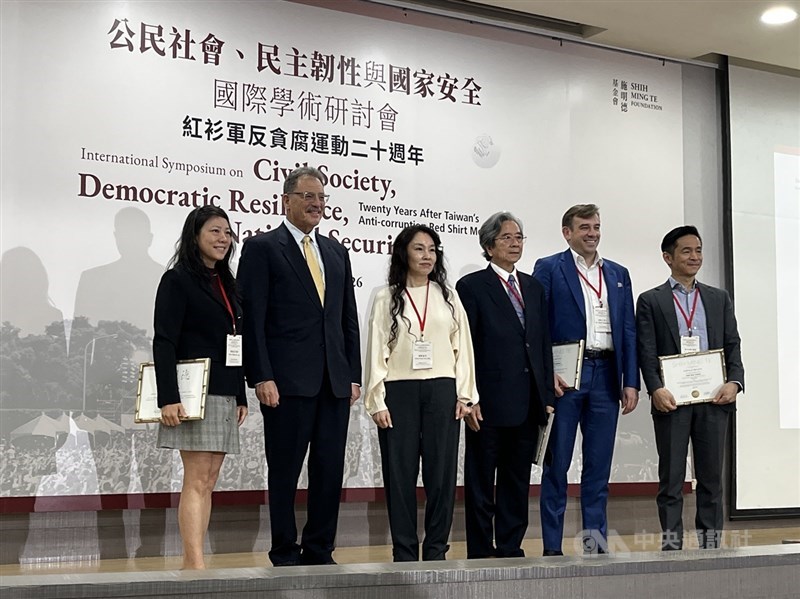
Templeman noted that Lai won the presidency with about 40 percent of the vote, while support for the largest opposition party in the legislative election was also well below a majority.
"So neither one has a strong mandate," he said. But "they both have a valid claim."
Taiwan's Constitution provides a mechanism for resolving serious executive-legislative conflict through a legislative vote of no confidence in the premier.
However, no such motion has passed since the mechanism was introduced through constitutional amendments in 1997.
If a no-confidence motion succeeds, the president may dissolve the Legislature and call new elections, giving lawmakers little incentive to "pull the trigger," Templeman said.
"No legislator right now wants to run in elections tomorrow. They want to stay in office as long as they can," he said.
As a result, prolonged conflict between the executive and the Legislature is "a feature" rather than "a bug" of Taiwan's current system of divided government, Templeman argued.
He cited Premier Cho Jung-tai's (卓榮泰) refusal to countersign legislation passed by the opposition-controlled Legislature as one example of how those tensions have intensified.
Templeman said the move created an effective veto power for the premier, enabling the Cabinet to prevent eight bills passed by the Legislature from taking effect.
Need for an independent 'referee'
Persistent conflict between the executive and legislative branches makes an independent institution capable of resolving disputes between them "essential," Templeman said.
"This, in my mind, is where Taiwan's constitutional system today falls really short," he said.
He pointed to what he described as a "glaring weakness" in the appointment systems for the Constitutional Court, NCC and other independent bodies.
The Constitutional Court has 15 justices serving nonrenewable eight-year terms, with nominations made by the president and subject to legislative approval.
Templeman said the appointment schedule can allow a president who serves two four-year terms to nominate all members of the court over the course of two terms, potentially creating perceptions of political bias even when the justices themselves act independently.
He noted that by the end of both the Ma and Tsai administrations, the court consisted entirely of justices appointed during the respective president's time in office.
Even if justices act "completely nonpartisan" and professionally, such an arrangement can make it easier for political opponents to question the court's independence, he said.
Templeman also pointed to the NCC, whose commissioners are nominated by the premier and require legislative confirmation.
Under divided government, he said, nominees can be rejected by the Legislature, while prolonged disagreement can leave commission seats vacant and undermine the body's ability to operate.
"If the two sides can't agree on something, you need something better as a fallback position than the institution just ceases to function," Templeman said.
He added, however, that Taiwan has several "underappreciated institutional successes," citing the central bank, Central Election Commission and police administration as bodies that have retained a significant degree of independence.
"It would be good to learn from some of these strengths considering institutional reform," Templeman said.
- Business
Taiwan shares open higher
10/01/2026 09:07 AM - Sports
Men's archery, esports give Taiwan 2 more bronzes at Asian Games
09/30/2026 08:32 PM - Society
Cooler, wetter weather forecast in northern Taiwan next week
09/30/2026 07:25 PM - Politics
Taiwan, Belize sign agreements to enhance collaboration during FM's visit
09/30/2026 07:08 PM - Society
AGC Display Glass employees protest at MOL ahead of 10/5 strike
09/30/2026 06:53 PM