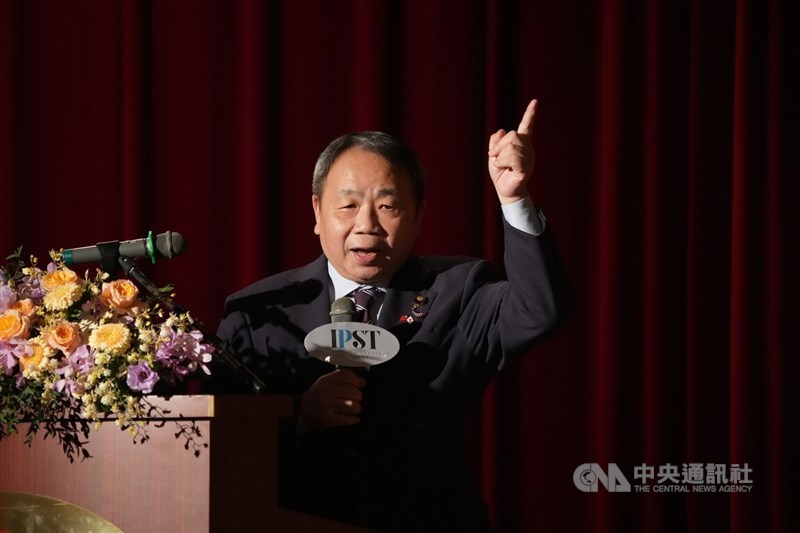
Taipei, Sept. 9 (CNA) Japan and Taiwan both face a growing Chinese military threat and should continue to strengthen their defensive capabilities to safeguard their democratic systems, visiting China-born Japanese lawmaker Hei Seki (石平) said Wednesday.
Speaking at a seminar in Taipei, Seki cited an old Chinese saying to illustrate the close relationship between Japan and Taiwan in the face of China's expansionism.
"If the lips are gone, the teeth will be cold," he said, indicating that Tokyo and Taipei are closely linked and that if one is attacked by Beijing, the other would also face immediate danger.
"As long as the Chinese Communist Party regime exists, it will never give up on invading Taiwan and Japan," he said.
For that reason, both countries have pledged to significantly increase their defense spending, as peace can only be achieved through strength, said Seki, a member of the Japan Innovation Party in the House of Councillors, the upper house of Japan's parliament.
He also called on Japan, Taiwan and the United States to strengthen their security alliance to deter Chinese aggression.
Born in China, Seki graduated from Peking University before moving to Japan to study in 1988, one year before the 1989 Tiananmen Square Massacre.
He became a naturalized Japanese citizen in 2007 and later worked as a university lecturer and political commentator before entering politics.
In September 2025, China's Ministry of Foreign Affairs announced sanctions against Seki over his China-critical stance, support for Taiwan, and visits to the controversial Yasukuni Shrine, which honors Japan's war dead, including convicted World War II war criminals.
The sanctions included a ban on entering China, including Hong Kong and Macau.
Meanwhile, Haruo Kitamura, another House of Councillors member representing the Conservative Party of Japan, agreed on the need for a stronger alliance between Japan, Taiwan and the United States to achieve an ideal espoused by late Japanese Prime Minister Shinzo Abe.
Speaking at the same seminar, Kitamura said Abe was the first to propose the concept of a Free and Open Indo-Pacific region that is "free, open, and inclusive," but that cannot be realized if peace and stability across the Taiwan Strait are jeopardized.
To Japan, Taiwan is a close friend "like family," while the United States is an important ally, Kitamura said.
"Should the three countries form a steadfast and strong alliance, together we can face any form of challenge," he said.
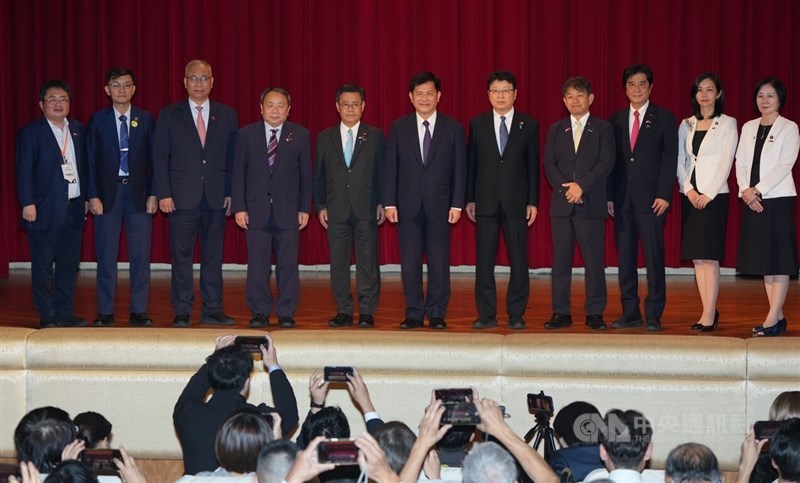
The two Japanese lawmakers made the remarks at a seminar on Japan-Taiwan security cooperation organized by the Taipei-based Indo-Pacific Strategy Thinktank.
Speaking at the opening of the half-day seminar, Foreign Minister Lin Chia-lung (林佳龍) said Taiwan, Japan and all countries in the First Island Chain should no longer be regarded as isolated points of defense amid escalating military coercion by the People's Liberation Army (PLA).
Instead, they should be understood as a "single theater" in which regional partners jointly maintain resilience, Lin said.
Within that single theater, unmanned systems are becoming a key component, and Taiwan and Japan are currently working hand in hand to complement each other's strengths in developing unmanned systems.
The goal is to create a "non-red supply chain" and provide capabilities for joint disaster response and defensive deterrence, he said.
- Politics
Panama legislature forms new Taiwan friendship group
09/09/2026 05:49 PM - Politics
Drones unlikely to offer Taiwan asymmetric edge over China: Expert
09/09/2026 05:38 PM - Politics
Japan, Taiwan bound by Chinese threat: China-born Japanese lawmaker
09/09/2026 05:33 PM - Society
More than 100 land on Caisancho Island to combat sand erosion
09/09/2026 05:21 PM - Society
Taiwan reports 30 mpox cases in 2026, imported infections double
09/09/2026 04:40 PM