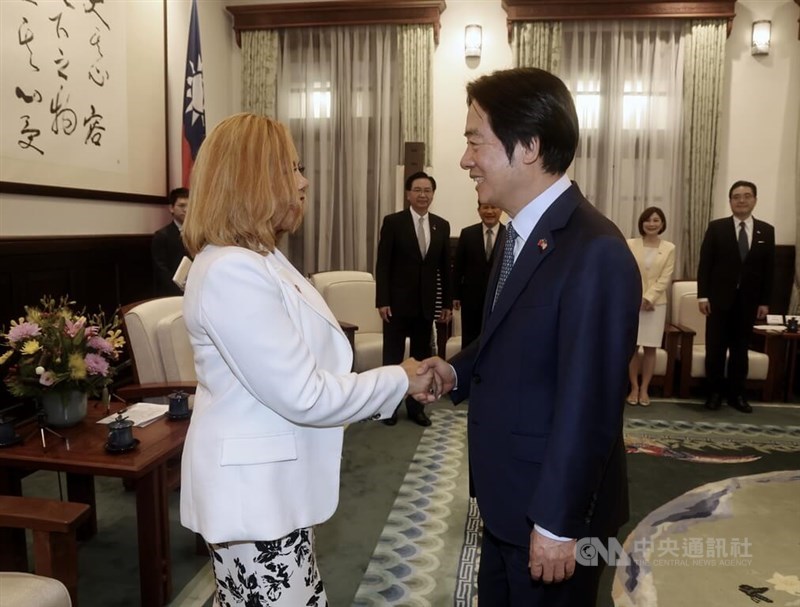
Taipei, June 18 (CNA) President Lai Ching-te (賴清德) met with two U.S. House representatives on Thursday, expressing hope to strengthen bilateral cooperation in defense, technology and industry, and urging the U.S. Congress to pass legislation preventing double taxation.
U.S. Representatives Lucy McBath, second vice chair of the Congressional Black Caucus (CBC), and Valerie Foushee, a member of the caucus, met with Lai at the Presidential Office as part of a five-day visit to Taiwan that concludes on Saturday.
Addressing the visitors, Lai thanked McBath, Foushee, and the U.S. Congress for their strong support of democratic Taiwan and their efforts to deepen U.S.-Taiwan relations.
In a rapidly changing international environment, Taiwan will continue to strengthen economic resilience and enhance self-defense capabilities, while expanding defense cooperation with the U.S. to jointly safeguard regional peace and stability, Lai said.
In addition, Lai pointed to deepening industrial ties between Taiwan and individual U.S. states, citing the Taiwan-U.S. Semiconductor Education Alliance, an initiative launched last month aimed at training workforce talent for the semiconductor and artificial intelligence industries.
Lai noted that McBath and Foushee represent the key U.S. tech hubs of Georgia and North Carolina as he advocated for expanded cooperation in AI and advanced sciences between the two sides.
Meanwhile, the president called on the U.S. Congress to expedite the passage of legislation preventing double taxation, which he said would reduce cross-border investment barriers and create a more favorable environment for commercial cooperation.
- Sports
Taiwan boosts medal haul in multiple events at Asian Games on Friday
10/02/2026 08:55 PM - Society
Workers at Taiwan snack maker Kuai Kuai extend strike over relocation
10/02/2026 08:45 PM - Business
Chain businesses association seeks more foreign workers
10/02/2026 08:04 PM - Politics
Shen unveils Taipei education platform, Chiang defends free lunches
10/02/2026 06:45 PM - Politics
Taiwan receives first 2 F-16V Block 70s (update)
10/02/2026 06:39 PM