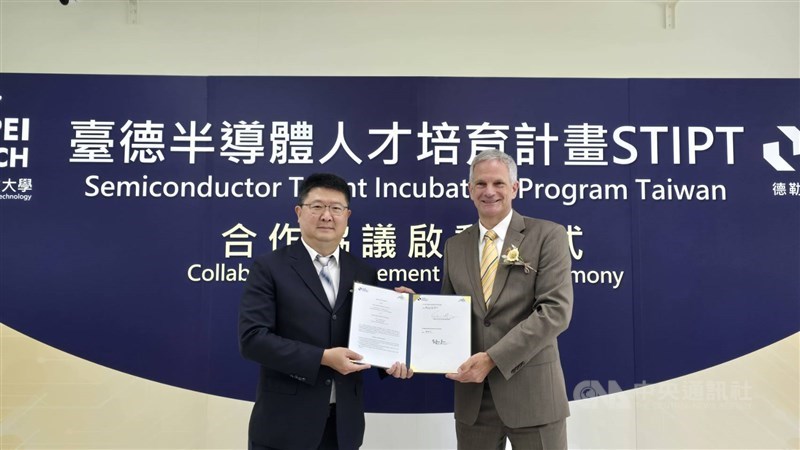
Taipei, Aug. 26 (CNA) National Taipei University of Technology (Taipei Tech) signed an agreement with Dresden University of Technology (TU Dresden) on Wednesday to join a Taiwan-Germany semiconductor talent development program.
The partnership will take effect this fall, making Taipei Tech the fourth Taiwanese university to participate in the Semiconductor Talent Incubation Program Taiwan (STIPT), Josef Goldberger, head of the Saxon Science Liaison Office Taiwan, told CNA.
As the program expands, the number of students from German universities coming to Taiwan each year is expected to rise from a previous maximum of around 70 to about 100, German Institute Taipei Director General Karsten Tietz said at the signing ceremony.
According to TU Dresden's website, the six-month program combines semiconductor-related coursework at a Taiwanese university with practical training at Taiwan Semiconductor Manufacturing Co. (TSMC) in Taichung.
STIPT was established in conjunction with TSMC's investment in Germany to cultivate the semiconductor talent needed in Dresden, Tietz said.
German students increasingly view semiconductors and artificial intelligence as promising career fields, while those in Dresden were among the first to recognize the opportunities created by the TSMC-led plant under construction there, he added.
"Taiwan is the world champion in this area," Tietz said, noting that the opportunity to study on the island and train at TSMC made the program attractive to German engineering students.
TSMC's investment has also raised awareness among German students of Taiwan's strength in microelectronics and electrical engineering, according to Goldberger.
"If we want to catch up, if we want to be part of the industry, we have to come to Taiwan to learn from Taiwan," he said.
Taipei Tech was selected because it offers English-language semiconductor courses at the master's level, has strong ties with German academia and responded quickly to the proposed partnership, Goldberger told CNA.
Taipei Tech President Jen Yi-Jun (任貽均) said the university and its German counterparts shared a focus on hands-on engineering education and industry-oriented research, providing a strong basis for cooperation in training students to solve real-world industrial problems.
Taipei Tech joins National Taiwan University, National Taiwan University of Science and Technology and National Yang Ming Chiao Tung University in STIPT.
National Cheng Kung University is scheduled to join in spring 2027, bringing the number of Taiwanese partners to five, Goldberger said.
Beginning this year, Germany's Federal Ministry for Research, Technology and Space and the Free State of Saxony will each fund half of the program's participants, according to Goldberger.
Selected students have their tuition and program fees covered and receive a monthly grant of 700 euros (US$816.5) and a travel allowance of 1,500 euros, according to TU Dresden's website.
- Politics
Eswatini king thanks Taiwan for helicopter donation
10/11/2026 04:38 PM - Society
Kaohsiung couple detained for abuse after 2-year-old daughter's death
10/11/2026 03:19 PM - Business
U.S. launches Section 337 probe involving Taiwan firms
10/11/2026 03:16 PM - Sports
Taiwanese men's, women's doubles pairs reach BWF Arctic Open finals
10/11/2026 01:51 PM - Society
Taiwan headline news
10/11/2026 01:15 PM