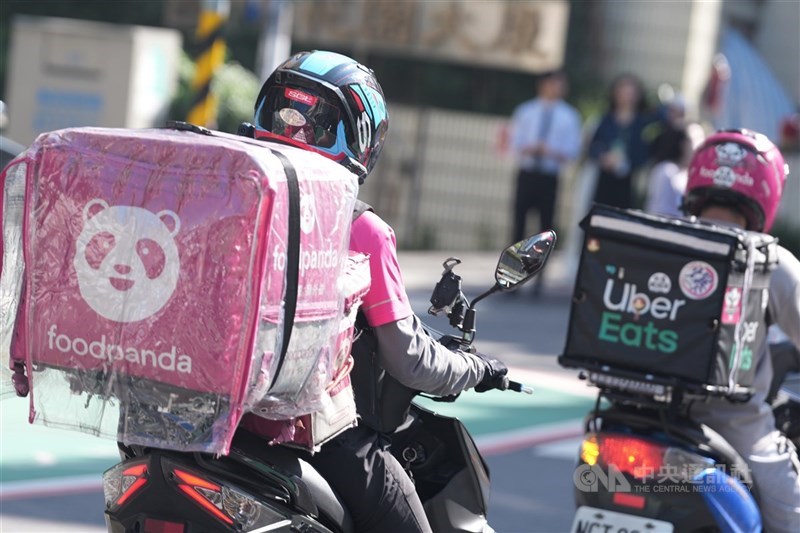
Taipei, July 20 (CNA) Taiwan's first dedicated law governing delivery platforms will take effect at midnight Tuesday, introducing measures that strengthen protections for delivery workers such as minimum pay guarantees and greater transparency requirements.
The Delivery Workers' Rights Protection and Delivery Platform Management Act will take effect alongside supporting regulations drawn up by labor, economic, transportation and health authorities, the Ministry of Labor (MOL) said in a statement Monday.
The regulations are intended to help create "a safer, more transparent and fairer delivery industry," the MOL said, noting the current power imbalance between delivery platforms and workers.
Delivery platforms have held greater market power through their control of order assignments, technology and big data, while delivery workers have less information and bargaining power and have to bear vehicle, fuel and safety costs, the MOL said.
The new law, passed by the Legislature on Jan. 6, mandates that delivery workers receive at least NT$45 (US$1.39) per order and no less than 1.25 times the statutory hourly minimum wage, calculated according to the time spent completing an order.
The guaranteed amount is to be adjusted annually in line with minimum wage increases, according to the new law. The current hourly minimum wage rate is NT$196.
Taiwan had more than 100,000 delivery workers as of last November, according to Labor Minister Hung Sun-han (洪申翰).
The law also requires platforms to disclose information about order assignments and pay calculations, establish reasonable grounds for suspending workers or terminating their contracts, and strengthen insurance protections for workers.
Concerns over higher prices
While delivery worker unions welcomed the legislation, delivery services raised the specter of higher costs being passed on to merchants and consumers.
Uber Eats, one of Taiwan's two leading food delivery platforms, said in April that it would raise service fees charged to restaurant partners by 2.5 percentage points and grocery partners by 3 percentage points from July 21, citing cost changes associated with the law.
In early June, the company said it would first seek to improve internal efficiency but would also consider raising charges for consumers.
Foodpanda, the other leading platform, said in late May that it was reviewing its internal processes to minimize the law's impact.
Although direct price increases have not yet been discussed, the company said it could not guarantee that prices would remain unchanged through the end of the year.
The MOL said in the statement that it will maintain a dialogue with platforms, delivery worker unions and relevant agencies after the law takes effect to address "practical disputes" and "implementation problems."
- Politics
Taiwan's parties ramp up campaigning ahead of Nov. 28 local elections
10/14/2026 09:21 PM - Politics
Belize PM vows stronger support for Taiwan after China sanctions
10/14/2026 09:07 PM - Business
Musk's Terafab plan poses no short-term threat to TSMC: Analyst
10/14/2026 08:22 PM - Society
Northern Taiwan to see showers Thursday as day-night temperature gap widens
10/14/2026 08:15 PM - Politics