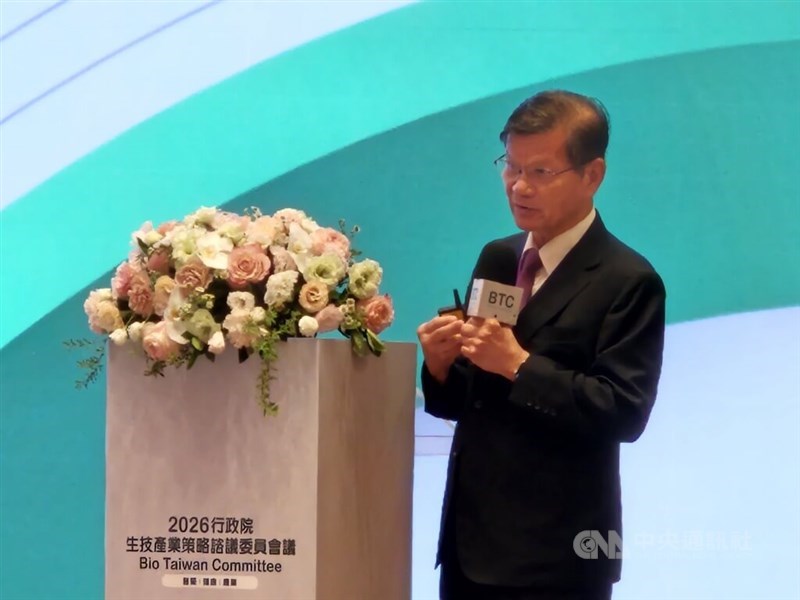
Taipei, Aug. 24 (CNA) Taiwan has an opportunity to become a global innovation hub for precision health by leveraging its strengths in biotechnology and information and communications technology (ICT), a scholar said at an annual biotech meeting in Taipei on Monday.
Wong Chi-huey (翁啟惠), a professor at Scripps Research in California and a distinguished research fellow at Academia Sinica's Genomics Research Center, made the remarks in a keynote speech at the opening of the three-day Bio Taiwan Committee (BTC) meeting in Taipei.
Wong, who is also a BTC member and former president of Academia Sinica, Taiwan's top academic research institution, said global medical spending is rising faster than economic growth as populations age.
Citing statistics, Wong said global medical spending was about US$10.6 trillion in 2018, accounting for 10.9 percent of global gross domestic product (GDP).
It is projected to reach US$15 trillion by 2030, when it is expected to account for 12.1 percent of GDP, creating growing demand for biomedical innovation focused on prevention and precision health, he said.
Taiwan, with its unique National Health Insurance (NHI) data and strong semiconductor and ICT sectors, is well positioned to use artificial intelligence (AI) and other technologies to become a global innovation hub for precision health, the prestigious scholar said.
Wong outlined four priorities for ushering in this new era. The first is to integrate NHI, human biobank and genomic data into an AI learning platform while keeping the data within institutions. The second is to leverage Taiwan's technological strengths to develop biomedical chips and smart healthcare computing.
The other priorities are to cultivate talent with expertise in both biomedicine and AI, and to strengthen international cooperation by participating in large-scale global research and development projects, he said.
Premier Cho Jung-tai (卓榮泰) and National Science and Technology Council Minister Wu Cheng-wen (吳誠文) were among the officials attending the event organized by the BTC, a national advisory body established by the Executive Yuan in 2005 to help shape biotechnology policy and guide the strategic development of Taiwan's biomedical industry.
Taiwan's biotech industry attracted NT$55.08 billion (US$1.7 billion) in investment last year and generated NT$805 billion in revenue, demonstrating its significant economic multiplier effect, Cho said.
He said the government hopes to revise and accelerate policies supporting biotechnology and medical technology to help the industry reach new heights and build a broader group of "national champions."
The premier said the government has been investing more in biotechnology through its Ten AI Initiatives Promotion Plan (2025-2028), with the sector playing a leading role in applying AI to healthcare.
Cho said the government also hopes to make health information generated through AI-enabled services more widely available for noncommercial academic research.
Meanwhile, Wu said the Executive Yuan's National Development Fund recently approved a 10-year, NT$10 billion investment program for Taiwan's biomedical industry to promote the development of the biotechnology and pharmaceutical sectors.
Wu said the government will continue promoting healthcare for older people, home-based medical care and remote healthcare, and hopes to combine Taiwan's strengths in semiconductors and AI hardware with its healthcare, pharmaceutical and medical device sectors to build a "smart biotech national team."
- Sports
Taiwan's Chen Yi-fan wins artistic skating gold at World Skate Games
10/09/2026 07:21 PM - Politics
Lai's National Day address to focus on Taiwan's economy, global role
10/09/2026 07:07 PM - Politics
Japanese lawmakers visit Taiwan for National Day celebrations
10/09/2026 07:02 PM - Culture
Czech, Taiwanese writers explore democracy, history at Frankfurt Book Fair
10/09/2026 07:00 PM - Society
China Youth Corps' designation as KMT-affiliated organization upheld
10/09/2026 06:09 PM