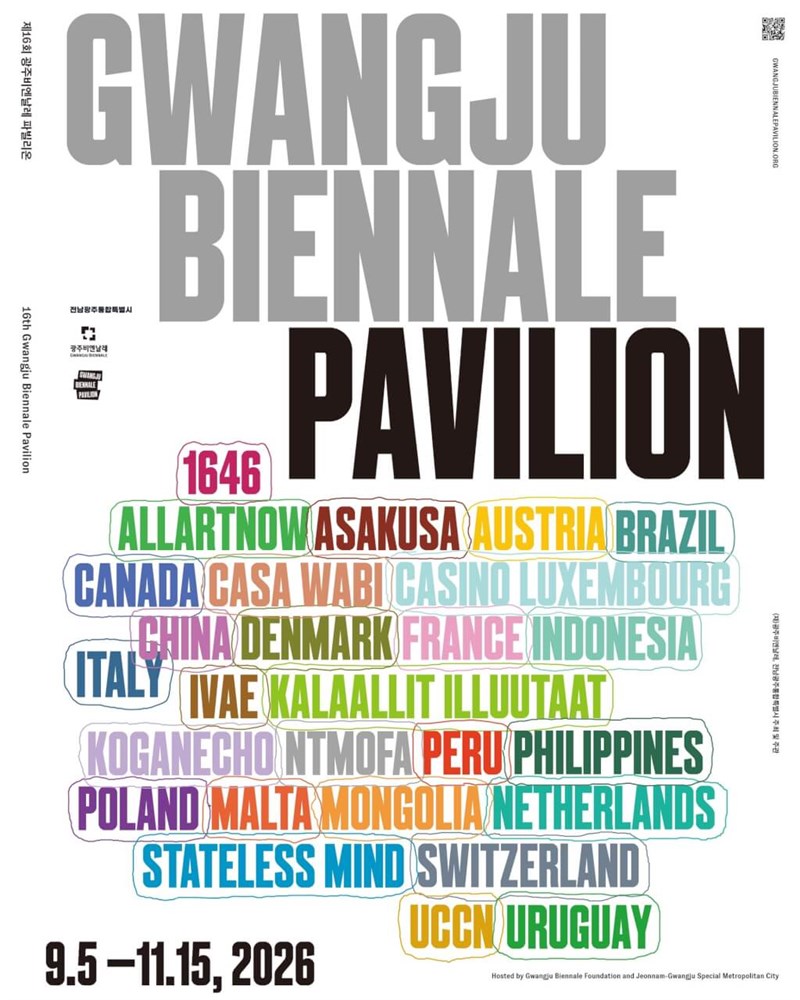
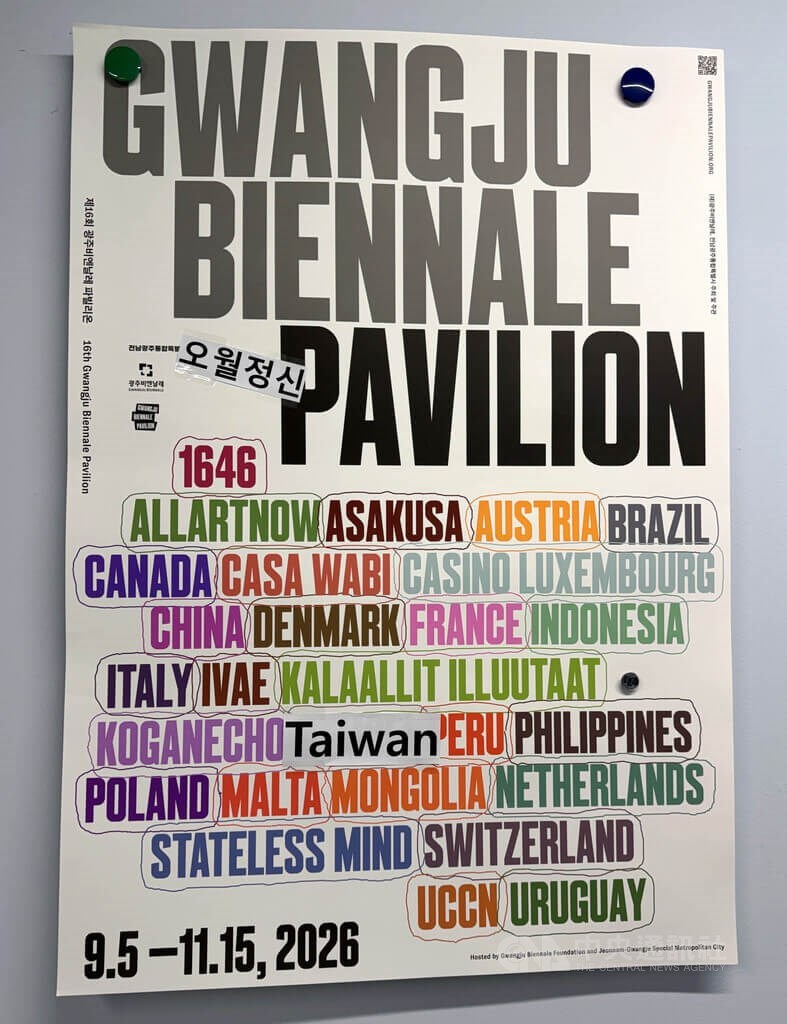
Taipei, Aug. 25 (CNA) Taiwan's Ministry of Culture (MOC) on Tuesday urged the Gwangju Biennale Foundation to respond by Wednesday to its request to restore the name of Taiwan's participating exhibition from "NTMoFA," the acronym for the National Taiwan Museum of Fine Arts, to "Taiwan Pavilion."
In a statement, the ministry "sternly protested" the foundation's and the Asia Culture Center's (ACC) refusal to restore the exhibition name and what it described as efforts to prevent Taiwan Pavilion personnel from entering the venue to set up the exhibition, originally scheduled to begin on Aug. 18.
However, while requesting a public response by Wednesday, the statement did not specify what action would be taken if the organizers failed to respond.
The ministry said it issued statements on Aug. 17 and Aug. 19 explaining that the agreed name of "Taiwan Pavilion" was changed to "NTMoFA" without discussion or prior notice.
The MOC also pointed to a statement issued Tuesday by the Taiwan Pavilion's curator and artists, titled "You Must Change Your Name," which accused the foundation of repeatedly ignoring the NTMoFA's objections to the name change and said an artistic institution should not become a tool for suppressing self-identification.
Over the past week, the ACC has refused to allow Taiwanese exhibitors to enter the venue to set up the exhibition, citing the lack of an official document from the Gwangju Biennale Foundation, the ministry said.
Although the NTMoFA received a copy of a foundation letter permitting them to enter the venue on Aug. 19, the ACC continued to say it had not received the document and refused to allow NTMoFA representatives to enter, the MOC said.
The ministry also said that after an NTMoFA representative took photographs to document the incident, ACC venue staff demanded to inspect the person's mobile phone and asked them to delete the photographs.
Furthermore, the foundation proposed relocating Taiwan's exhibition to an alternative storage space that was much smaller than the original exhibition site, the ministry said.
It argued that the various proposals and information provided by the organizers failed to clearly confirm the restoration of the exhibition's name or access to the agreed-upon venue.
These actions reflected only that "the Gwangju Biennale Foundation and the Asia Culture Center intended to obstruct Taiwan's exhibition in various ways, ultimately preventing it from completing its setup as scheduled."
The MOC added that members of the international artist community and art workers had also spoken out, calling on the foundation not to use its authority to determine the name under which participants are identified and to restore the name "Taiwan Pavilion" as soon as possible.
The MOC also "strongly demanded" that the foundation honor its agreement and allow the Taiwan Pavilion to enter the ACC venue and set up the exhibition under the agreed-upon name.
The ministry urged the foundation not to "cast a shadow" over the "Gwangju Spirit."
Gwangju foundation's argument
In response, the Gwangju Biennale Foundation said it would neither intervene in nor censor the content or expression of exhibitions, and would continue negotiations to ensure that the NTMoFA's exhibition proceeds as planned.
The foundation said the exhibition project is purely an artistic partnership and that it has never intervened, nor would intervene, in the NTMoFA pavilion's curation, selection of works, installation methods or the expressions of its curator and artists.
It was concerned that the controversy had developed into a political and diplomatic issue, the foundation said, adding that the dispute stemmed from differing interpretations of administrative procedures and the agreement concerning the pavilion's participating institution and how it should be labeled in official promotional materials.
The foundation contended that the agreement signed on Jan. 12 clearly identified the Gwangju Biennale Foundation and the National Taiwan Museum of Fine Arts as the parties involved and that its implementation was based on that agreement.
In contrast, Taiwan's Ministry of Culture has insisted that the original agreement was that the name "Taiwan Pavilion" would be used and was only changed by the foundation in June.
The foundation argued that the labeling used in official documents and promotional materials should be distinguished from the exhibitor's own self-identification.
Regarding the difficulties encountered by Taiwan's exhibitors at the ACC, the foundation said it had signed a contract with the venue for use of the exhibition space, but the contract did not specify the countries or institutions that would hold exhibitions there.
It said it would ask the ACC to open the space and cooperate with the installation and exhibition operations so that the NTMoFA's exhibition can proceed as planned.
If further delays or difficulties arise, the NTMoFA could consider using an alternative space inside the Gwangju Biennale venue, it added.
The foundation concluded that both the autonomy of exhibitors and the official operations stipulated in the agreement should be respected, saying the priority was not for the two sides to "more loudly propagate their own stance" but to quickly find a workable solution that would allow the exhibition to be held as scheduled.
- Politics
China-born spouse denied right to run for local office in Hsinchu
10/07/2026 08:59 PM - Society
Taiwan Railway apologizes after train blows past station
10/07/2026 07:52 PM - Politics
Defense company executives underscore autonomous capabilities at forum
10/07/2026 07:06 PM - Business
Micron Taoyuan union secures strike authorization, weighs 'surprise strike'
10/07/2026 06:42 PM - Politics
KMT lawmaker to propose tougher penalties for drug-impaired driving
10/07/2026 05:29 PM