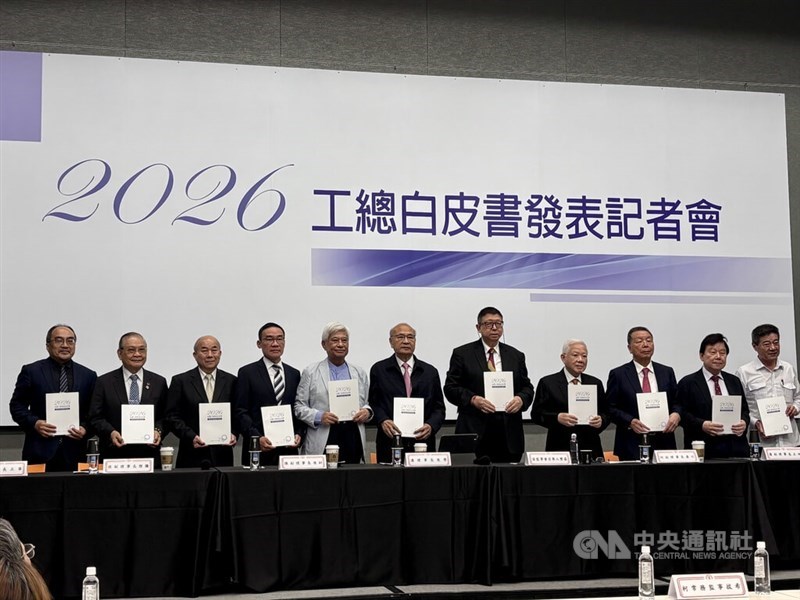
Taipei, Aug. 24 (CNA) The Taiwan-based business group Chinese National Federation of Industries (CNFI) issued its 2026 white paper on Monday, raising concerns over labor shortages among other major issues facing the country's industrial development.
At a news conference, where the white paper was released, CNFI vice chairman Chan Cheng-tien (詹正田) said a shrinking birth rate and aging population have worsened the labor shortage in Taiwan and the lack of workers is a pressing challenge facing the country in terms of enhancing industrial innovation and economic resilience.
The white paper suggested the government should review its policy on migrant workers by shifting from a focus on the 3K industries -- Kiken (dangerous), Kitanai (dirty) and Kitsui (intense) -- to one guided by actual labor shortages.
In addition, the CNFI also urged the government to extend the length of time industrial migrant workers can stay in Taiwan from 12 to 14 years, while seeking alternative sources of migrant workers in other populous emerging countries beyond Vietnam, Thailand and Indonesia.
Citing the white paper, Hou Chieh-teng (侯傑騰), another CNFI vice chairman, told reporters that the government should also diversify Taiwan's energy resources by not relying on energy imports.
Current tensions in the Middle East have highlighted the issue as geopolitical unease has created volatility in the global energy market, he noted.
The CNFI said in the white paper that faced with growing power demand, Taiwan should include nuclear power in its national energy portfolio and continue to push for renewable energy development, as a way to enhance energy resilience.
The business group said the government should also review the rationality of electricity pricing and set up a stable and predictable electricity pricing mechanism in a bid to balance the electricity burden on both residential and industrial users.
To maintain Taiwan's global competitive edge, the CNFI urged the government to slow down the introduction of a carbon emissions cap and emissions trading system (ETS) in Taiwan, which could result in higher operating costs.
On the other hand, the business group called on the government to speed up the launch of a Taiwan-based carbon border adjustment mechanism (CBAM) to prevent carbon leakage and unfair competition caused by the import of high-carbon emissions products.
At the news conference, CNFI chairman Pan Chun-jung (潘俊榮) said that in addition to energy policy, the business group also considers industrial transformation to be a top priority.
Taiwan cannot rely only on a high-tech sector driven by AI to boost its economy, while the old-economy sector which is the foundation of the country's industrial development, still needs assistance in upgrading, Pan said.
A survey conducted by the CNFI showed 76.6 percent of its members said the labor shortage is their top concern, 75.7 percent indicated they paid close attention to industrial transformation, and 63.1 percent focused on the government's energy policies, while 54.1 percent and 46.8 percent emphasized emissions reduction policies and international trade, respectively.
- Sports
Taiwan's Chen Yi-fan wins artistic skating gold at World Skate Games
10/09/2026 07:21 PM - Politics
Lai's National Day address to focus on Taiwan's economy, global role
10/09/2026 07:07 PM - Politics
Japanese lawmakers visit Taiwan for National Day celebrations
10/09/2026 07:02 PM - Culture
Czech, Taiwanese writers explore democracy, history at Frankfurt Book Fair
10/09/2026 07:00 PM - Society
China Youth Corps' designation as KMT-affiliated organization upheld
10/09/2026 06:09 PM