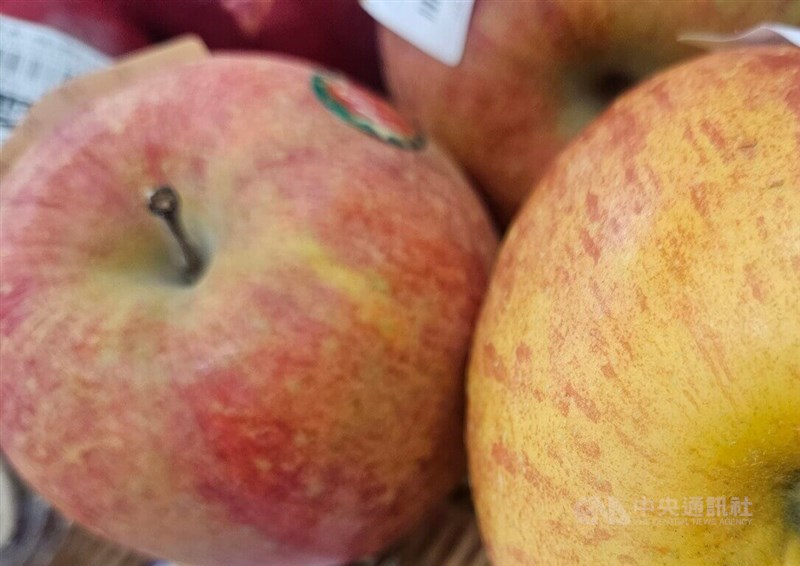
Taipei, July 13 (CNA) Taiwan's Food and Drug Administration (TFDA) on Monday denied online claims that it has relaxed the maximum allowable residue limit for the pesticide fipronil in apples, saying no such standard exists and warning that anyone spreading the false claim could face criminal penalties.
The clarification came after Facebook posts falsely claimed that the TFDA had increased the allowable residue limit for fipronil in apples sixfold.
TFDA Food Division Director Hsu Chao-kai (許朝凱) told reporters the claim is false and has unnecessarily raised public concerns about the safety of apples.
Hsu said the pesticide involved in the recent revision to apple residue regulations was fenpropathrin, not fipronil, stressing that the two are completely different substances.
Fipronil is an environmental insecticide used to control pests such as termites and ants and is not approved for agricultural use, while fenpropathrin is legally permitted for use on fruit and vegetables, with individual residue limits already established for crops including grapes and wax apples, according to Hsu.
Previously, apples were subject to the residue limit for the broader "pome fruit" category. The revised regulation establishes a crop-specific residue limit for apples, similar to those already in place for grapes and wax apples, Hsu said.
According to Hsu, a multinational company applied in 2022 to establish an individual residue standard for apples, submitting field trial data that met regulatory requirements. The revision of maximum residue limits (MRLs) for pesticides was made in line with international practice and reflects actual pesticide use, rather than a relaxation of food safety standards, he said.
Hsu also dismissed online speculation that the revision resulted from U.S. pressure or political trade-offs, including any link to the proposed Taiwan-U.S. Agreement on Reciprocal Trade.
Pesticide residue limits are established through scientific risk assessments based on domestic and international data, toxicological studies, field trial results and Taiwanese dietary consumption patterns, he said.
The TFDA has compiled evidence related to the false social media posts and referred the case to local authorities for investigation, Hsu said. It has also asked Meta to remove the misleading posts in accordance with the platform's policies.
Under Article 46-1 of the Food Safety and Sanitation Act, anyone who intentionally spreads false or misleading information about food safety can face up to three years in prison, criminal detention or a fine of up to NT$1 million (US$31,126), Hsu said.
The TFDA noted that it refuted earlier food safety rumors at a press conference in May and issued clarifications through news releases and posts on its official Facebook page, urging the public to verify information before sharing it.
- Sports
Taiwan boosts medal haul in multiple events at Asian Games on Friday
10/02/2026 08:55 PM - Society
Workers at Taiwan snack maker Kuai Kuai extend strike over relocation
10/02/2026 08:45 PM - Business
Chain businesses association seeks more foreign workers
10/02/2026 08:04 PM - Politics
Shen unveils Taipei education platform, Chiang defends free lunches
10/02/2026 06:45 PM - Politics
Taiwan receives first 2 F-16V Block 70s (update)
10/02/2026 06:39 PM