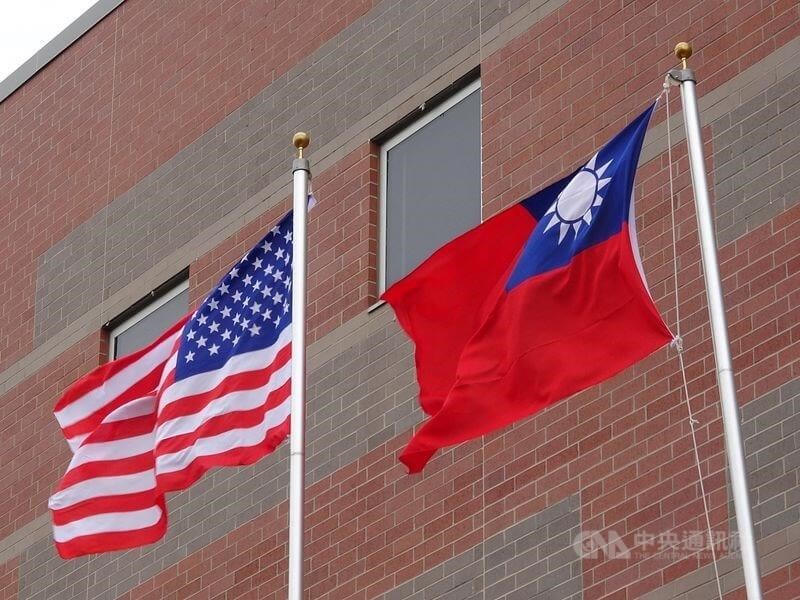
Taipei, May 28 (CNA) Taiwan's vice premier on Thursday called on Washington to clarify tariff exemption quotas and preferential treatment outlined in an investment memorandum of understanding (MOU) signed in January, as the United States considers imposing protective tariffs on semiconductor imports.
Although Taiwan's semiconductor exports to the U.S. are currently exempt from tariffs, Vice Premier Cheng Li-chiun (鄭麗君) said at a news conference that the U.S. side had "repeatedly" stated during bilateral trade talks that it could impose tariffs on global semiconductor imports, including those from Taiwan, under Section 232 of the Trade Expansion Act on national security grounds.
Cheng referenced an MOU signed between the two sides in January under which the U.S. agreed to grant Taiwanese semiconductor manufacturers tariff-free export quotas and preferential treatment, in exchange for direct investments by Taiwanese technology companies to expand advanced semiconductor, energy and AI production in the U.S.
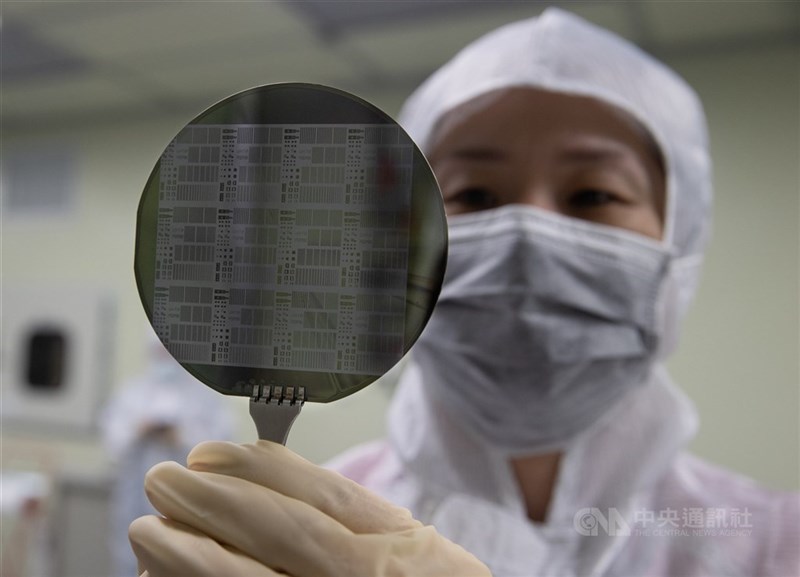
"We hope the preferential treatment can be confirmed first. The government will help businesses negotiate their individual tariff-exempt quotas and covered items," Cheng said.
"We further hope that if the U.S. imposes Section 232 tariffs on semiconductors, they will be implemented afterward to reduce uncertainties facing our businesses investing in the U.S.," she said.
Cheng, who leads Taiwan's negotiating team in trade talks with Washington, said Taiwan had conveyed this position to the U.S. during previous rounds of negotiations.
Under the MOU, Taiwanese technology companies building semiconductor production facilities in the U.S. would be allowed to export semiconductors equivalent to up to 2.5 times their planned U.S. production capacity without paying Section 232 duties.
Taiwanese companies that have completed new chip production projects in the U.S. would still be able to import semiconductors equivalent to 1.5 times their new U.S. production capacity without paying Section 232 duties, according to the MOU.
Asked when she expected Washington to announce Section 232 tariffs, Cheng said "hopefully not too soon," while calling on the U.S. to take into account the "complementary" nature of the two sides' high-tech industries in its decision-making.
At the news conference, Cheng also announced that the U.S. had waived Section 232 tariffs on Taiwanese auto parts, timber, lumber and wood derivative products pursuant to the January MOU on bilateral trade.
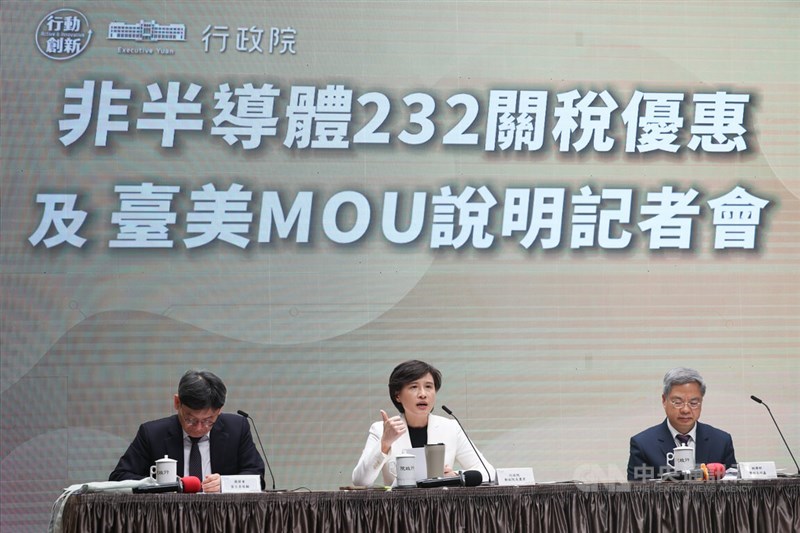
Citing a document published Thursday by the Office of the United States Trade Representative, Cheng said tariffs on auto parts had been cut from 26.71 percent to 15 percent, in line with rates applied to the European Union, South Korea and Japan.
Meanwhile, tariffs on wooden furniture had been reduced from 25 percent to 15 percent, while those on aircraft parts and components categorized as aluminum, steel, or copper derivatives -- previously ranging from 15 percent to 51.12 percent -- have been lowered to 1.12 percent, Cheng said.
The new tariff rates will be retroactively applied to May 1, she added.
- Society
Taiwan headline news
10/03/2026 10:22 AM - Sports
'Hao-yu like that?' A deep dive into Lee's rookie MLB season
10/03/2026 10:00 AM - Sports
Taiwan boosts medal haul in multiple events at Asian Games on Friday
10/02/2026 08:55 PM - Society
Workers at Taiwan snack maker Kuai Kuai extend strike over relocation
10/02/2026 08:45 PM - Business
Chain businesses association seeks more foreign workers
10/02/2026 08:04 PM