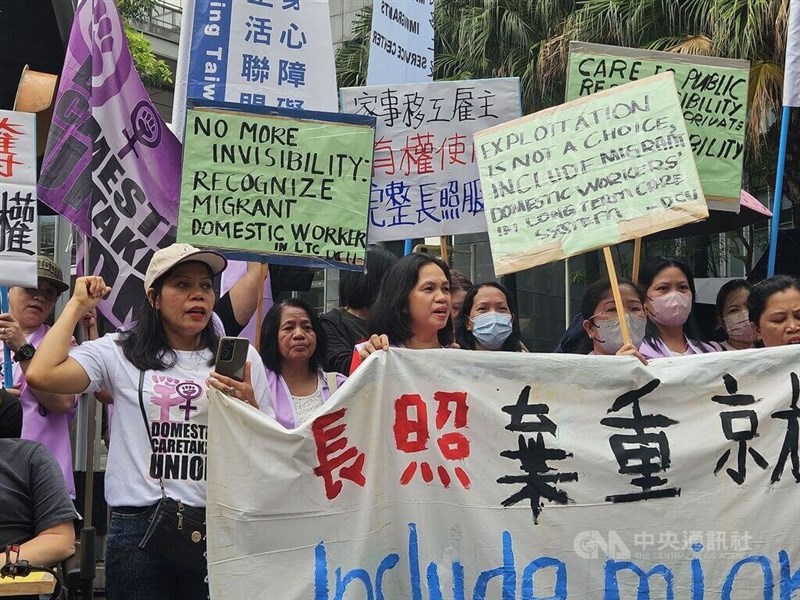
Taipei, June 14 (CNA) Labor groups on Sunday urged the government to allow household migrant caregivers to be hired and managed by long-term care agencies, saying the move would prevent overwork and better protect the interests of care recipients and those providing care.
"Exploitation is not a choice," protesters chanted at a rally outside the Ministry of Health and Welfare (MOHW) in Taipei on Sunday, two days before International Domestic Workers Day on June 16.
Among the roughly 50 people who attended was Jogilyn, a representative of the Domestic Caretaker Union, a group made up mainly of Filipino caregivers in Taiwan.
"Many of us continue to face long working hours, limited opportunities for rest and leave, and increasing care responsibilities that often exceed what one worker can reasonably provide," Jogilyn said in her speech.
The right to rest and take leave is "a fundamental labor and human right," she said.
Napia, a representative of Indonesian migrant caregiver union SBIPT, said caregivers working 24 hours a day also affected the quality of care received by older adults and people with disabilities, hurting family interests as well.
Little rest the norm
Currently, household migrant caregivers and domestic helpers in Taiwan -- totaling than 210,000 people, mainly from Indonesia, the Philippines and Vietnam -- are excluded from the Labor Standards Act, which mandates regular rest days or daily working-hour limits.
Many of them are live-in caregivers, who are responsible for the people they care for around the clock and rarely get time off.
In a statement in January 2026, the Ministry of Labor (MOL) said a June 2025 survey found that 65.8 percent of household migrant caregivers had at least one day off per month, with the largest share, 31.7 percent, taking an average of one day off per month.
Taiwan International Workers' Association official Wu Jing-ru (吳靜如) said civil groups have for years advocated incorporating household migrant caregivers into Taiwan's long-term care workforce by having long-term care service agencies serve as their employers.
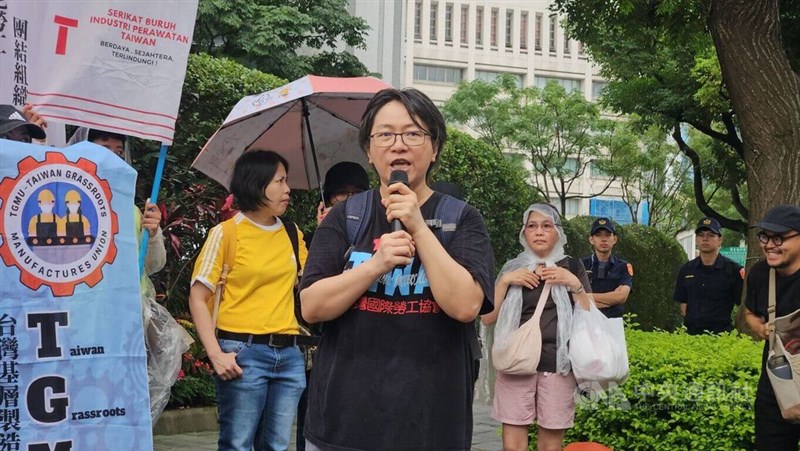
Unlike caregivers hired directly by individual families, those employed by agencies would be covered by the Labor Standards Act, giving them clearer protections on wages, working hours and rest days.
Under such a model, families would no longer have to shoulder employer responsibilities and would instead return to the role of service users, while agencies would dispatch migrant caregivers and other care workers based on users' needs, Wu said.
That would help provide stable and professional home-based care while ensuring better labor protections for household migrant caregivers, she said.
Employers: Reform, not abolish
The International Association of Family and Employers with Disabilities, an NGO formed by employers of migrant caregivers, issued a statement later Sunday in response to the labor groups's demands.
It described the current family-based hiring system as an important supplement to Taiwan's long-term care system, and suggested reforming rather than abolishing it.
Before the government thinks about incorporate migrant caregivers into the long-term care system, it should first establish rules on professional qualifications, contractual responsibilities and quality control to improve the current system, the group said.
MOHW: Ready to assess
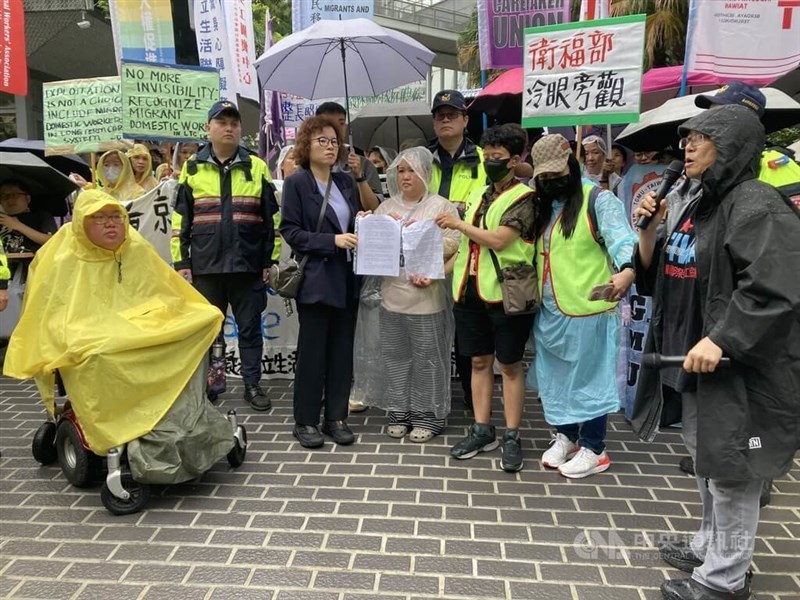
Responding to the appeal, Wu Hsi-wen (吳希文), deputy head of the MOHW's Department of Long-Term Care, said the proposed change would require "wide-ranging" regulatory changes and "careful" assessment.
If care recipients still required 24-hour care under such a model, services might have to be provided through rotating shifts, Wu said, noting that this would be significantly different from the current service model.
She added that the government would also have to consider rules under the Employment Service Act, including the principle that the employment of foreign workers should not harm the job opportunities or working conditions of Taiwanese nationals.
The MOHW will continue gathering views from different sectors and assessing the potential impact on stakeholders, she said.
CNA also reached out to the MOL for comment, but the ministry said the policies in question fall under the MOHW's jurisdiction and should therefore be addressed by the health ministry.
- Politics
Taiwan-donated patrol vessel handed to Philippine Coast Guard: Source
09/22/2026 09:13 PM - Business
Taiwan's export orders hit record high in August, surge over 70%
09/22/2026 08:15 PM - Culture
Migrant workers' award-winning photos exhibited at NTCH
09/22/2026 07:46 PM - Politics
Army unveils Stinger simulators, highlights counter-drone role
09/22/2026 07:39 PM - Politics
Labor minister says no 'downgrading' at China APEC meeting
09/22/2026 07:19 PM