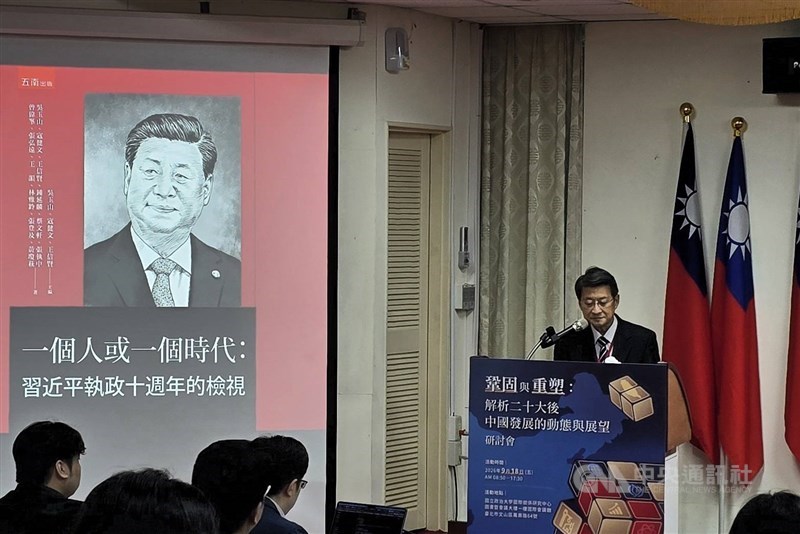
Taipei, Sept. 18 (CNA) Chinese President Xi Jinping (習近平) may pose the greatest risk to Taiwan when facing political challenges at home while still retaining the power to act, rather than when his grip on China's leadership is most secure, a Taiwanese scholar said Friday.
Academia Sinica academician Wu Yu-shan (吳玉山), a distinguished research fellow at the institution's Institute of Political Science, made the remarks after delivering a keynote speech at a seminar hosted by National Chengchi University's Institute of International Relations.
"Many people believe that the stronger Xi becomes, the greater the threat to Taiwan. I don't see it that way," Wu told reporters after the speech.
"If he has full control at home, he can wait longer. He has no need to take risks," Wu said. "But when he is challenged, he will instead have to respond more forcefully."
Wu framed his analysis of China's leadership succession within a broader trend he calls "ReMaoization," referring to the concentration of power under Xi, the expansion of party-state control over society and the erosion of political norms established after the Mao Zedong (毛澤東) era.
Those changes have eroded established succession practices, making the outcome of the Chinese Communist Party's (CCP) 21st National Congress next year consequential not only for Chinese politics but also for Taiwan, Wu said.
Against that backdrop, Wu said the most dangerous scenario for Taiwan would be a repeat of the pattern established at the previous congress.
Under that scenario, Xi would remain in power while other senior leaders continued to retire according to customary age limits, making him the sole exception to the rules.
That disparity would raise questions within the CCP about the legitimacy of Xi's continued rule, increase the likelihood of further purges and give him a greater incentive to demonstrate strength abroad, Wu said.
Xi would therefore have both the motivation and capability to take "decisive action," he added.
By contrast, Wu said a scenario resembling the leadership model under former Soviet leader Leonid Brezhnev could be more conducive to stability across the Taiwan Strait.
Under what Wu called the "Brezhnevian model," Xi and multiple senior officials would remain in office together, giving the CCP's top leaders a shared interest in preserving the existing leadership.
Although that arrangement could produce an aging and inflexible political system, it would make Xi's position more secure and reduce his need to adopt an aggressive external posture for domestic political reasons, Wu said.
"I personally hope the CCP moves toward the Brezhnevian model, although I cannot be certain that it will," Wu said.
- Business
Taiwan shares close up 1.93%
09/18/2026 02:35 PM - Politics
New Taiwan-Matsu cable boosts communications resilience: Premier
09/18/2026 02:34 PM - Politics
Xi most dangerous to Taiwan when challenged at home: Scholar
09/18/2026 02:01 PM - Business
Early buyers snap up iPhone 18 Pro models
09/18/2026 12:43 PM - Politics
U.S. remains committed to first island chain deterrence: MAC official
09/18/2026 11:23 AM