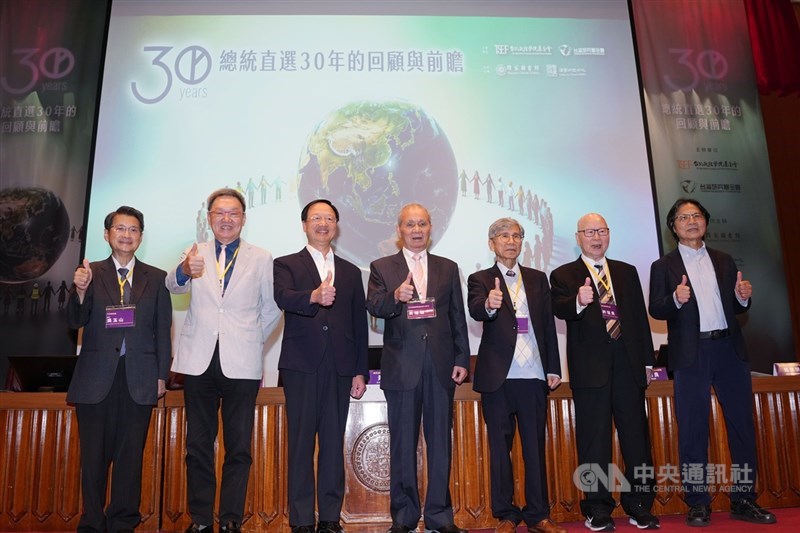
Taipei, Sept. 12 (CNA) Amending the Constitution is not the answer to Taiwan's political deadlock over disputed legislation and judicial appointments, panelists at a Taipei seminar said Saturday, calling instead for dialogue between the ruling and opposition parties.
Former Democratic Progressive Party (DPP) Chairperson Hsu Hsin-liang (許信良) argued that constitutional amendments were virtually impossible because of the high legal threshold, while existing institutional shortcomings could be addressed through political consensus and constitutional practice.
"What Taiwan needs now is... a moment of grand reconciliation," Hsu said.
He was referring to the stalemate between the Cabinet and the opposition-controlled Legislature over bills the Cabinet has declined to countersign and implement, as well as the Legislature's repeated rejection of presidential nominees to the Constitutional Court.
The panel took place on the second day of a two-day seminar marking three decades since Taiwan's first direct presidential election in 1996.
Turning to Taiwan's governmental structure, Hsu said that it was modeled on France's semi-presidential system during constitutional reforms in the 1990s, although political circumstances prevented Taiwan from adopting the model in full.
Under Taiwan's dual-executive system, the popularly elected president appoints the premier without legislative confirmation, while the premier heads the Executive Yuan and is accountable to the Legislature.
Any effort to improve that system should draw on the French model rather than introduce changes without considering the original institutional design, Hsu argued.
He cited France's restrictions on legislation that increases government expenditure and its mechanisms for reviewing bills concerning government organization as relevant to Taiwan's current disputes.
Former Premier Jiang Yi-huah (江宜樺) likewise opposed amending the Constitution to require legislative approval of the premier's appointment, saying such a change would involve complex considerations and could create further problems.
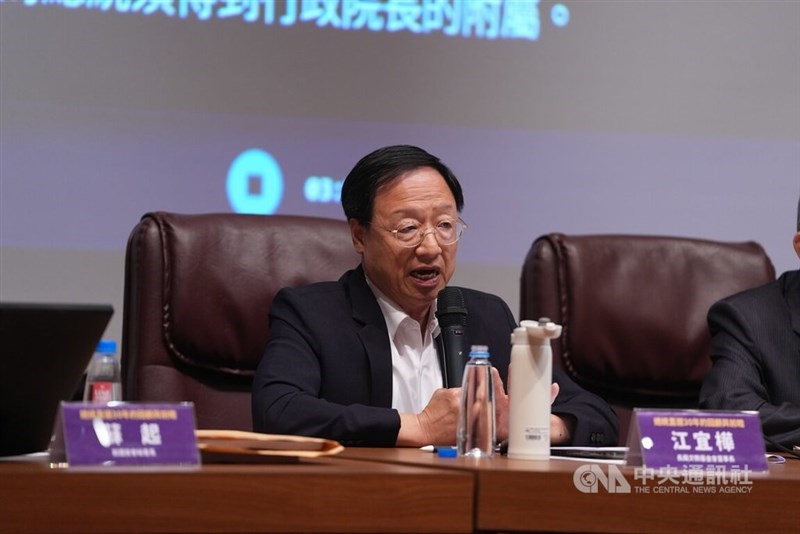
The two nevertheless disagreed over responsibility for the current confrontation.
Criticizing the Cabinet's refusal to countersign and implement certain bills after reconsideration motions had failed, Jiang argued that the practice violated the principle of separation of powers.
Hsu agreed that the premier's countersignature power was intended to restrain the president rather than the Legislature, but maintained that the opposition had first violated constitutional principles by passing legislation that increased government expenditure.
Despite those differences, both emphasized that institutional design alone could not resolve political conflict.
"Without reconciliation, compromise and concessions, democratic politics cannot work, regardless of how the Constitution is designed," Jiang said.
Hsu said the bipartisan cooperation that made possible the National Affairs Conference (國是會議) and constitutional reforms of the 1990s should serve as a model for today's political parties.
Then-President Lee Teng-hui (李登輝) of the Kuomintang agreed to convene the National Affairs Conference in the summer of 1990, bringing together then-opposition DPP members and protesters to address their concerns.
The delegates laid the foundation for ending the tenure of the lifetime National Assembly members elected in 1947, paving the way for Taiwan's first direct presidential election in 1996 and full re-elections of Taiwan's legislative bodies.
Yeh Jiunn-rong (葉俊榮), a chair professor at National Taiwan University's College of Law, similarly urged politicians and political parties to remain faithful to the constitutional order.
"Political figures and parties must engage in dialogue, be willing to engage in dialogue and have confidence in dialogue," Yeh said.
- Society
Seasonal winds to keep Taiwan cool but moisture declines: CWA
10/06/2026 11:30 AM - Politics
U.S. Senator Michael Bennet visits Taiwan
10/06/2026 10:40 AM - Society
Taiwan headline news
10/06/2026 10:18 AM - Business
U.S. dollar down in Taipei trading
10/06/2026 10:15 AM - Business
Taiwan shares open higher
10/06/2026 09:09 AM