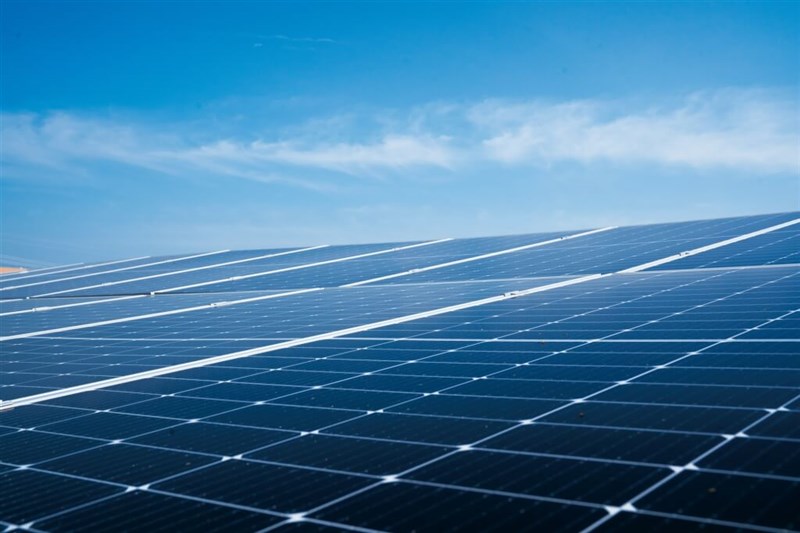
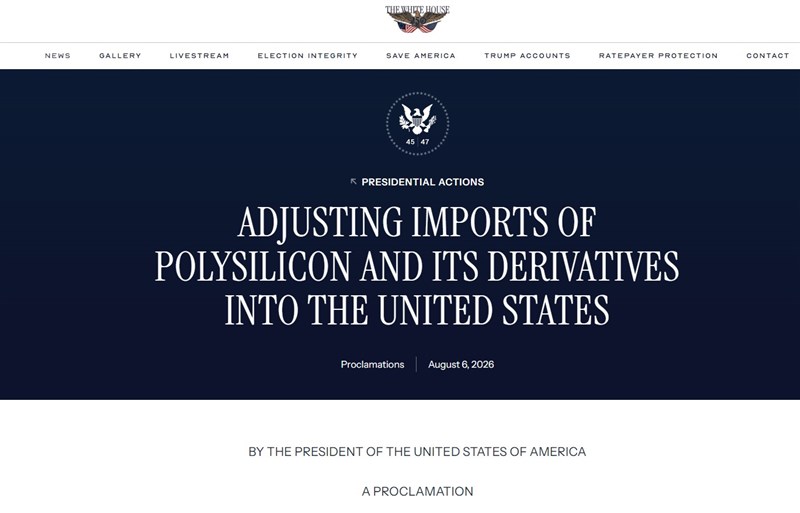
Washington, Aug. 6 (CNA) U.S. President Donald Trump signed an executive order Thursday imposing minimum import prices (MIP) and a 15 percent tariff on polysilicon -- the primary raw material used to manufacture semiconductors and solar panels -- and related products.
The new duties, which take effect Dec. 4, will apply in addition to any other tariffs, taxes or fees on the affected products, according to a statement released by the White House.
However, for imports from Japan, South Korea, Taiwan, Switzerland, Liechtenstein and European Union member states, the combined tariff rate will be capped at 15 percent.
The tariff rate on products from the United Kingdom will be capped at 10 percent.
The minimum import prices are set at US$21 per kilogram for polysilicon, US$100 per kilogram for polysilicon ingots and wafers, US$0.22 per watt for solar cells and US$0.38 per watt for solar modules.
The measures follow a year-long investigation by the U.S. Department of Commerce, which found that imports had "eroded" the capacity of the U.S. polysilicon industry. The White House said the U.S. share of global polysilicon production capacity fell from 50 percent in 2005 to less than 2 percent in 2024.
"These tariffs -- combined with the MIP program -- will promote United States production of polysilicon derivatives by ensuring a commercially viable market for them," Trump said in the statement.
- Business
Taiwan drone maker partners with North American group to boost exports
09/18/2026 08:58 PM - Politics
Taiwan welcomes delegates for launch of global disaster alliance
09/18/2026 08:24 PM - Politics
CEC to hold 5 televised forums, debates on nuclear referendum
09/18/2026 08:16 PM - Business
Taiwan freezes electricity rates to support economy
09/18/2026 07:36 PM - Politics
President Lai attends eastern Taiwan quake drill observed by 18 countries
09/18/2026 06:59 PM