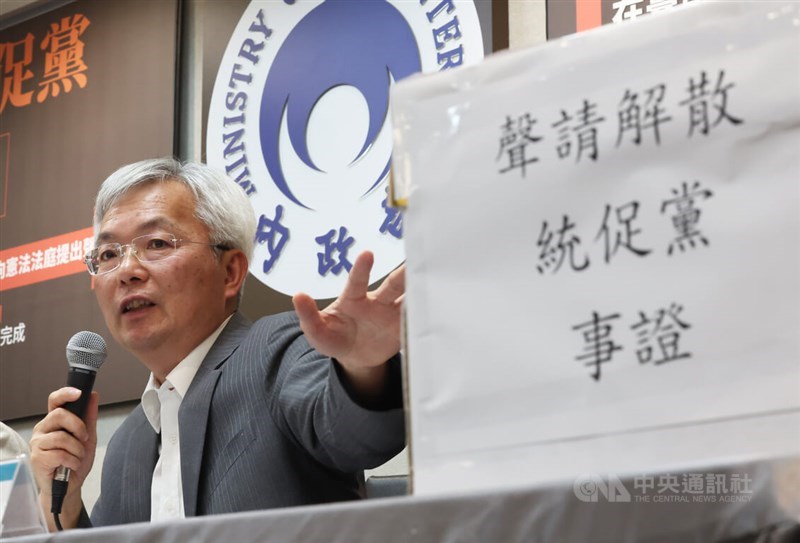
Taipei, July 30 (CNA) The Ministry of the Interior (MOI) said Thursday it will petition the Constitutional Court in early August to dissolve the pro-China Chinese Unification Promotion Party (CUPP), accusing it of systematically engaging in activities that threaten national security and Taiwan's free democratic constitutional order.
At a press conference, Interior Minister Liu Shyh-fang (劉世芳) said the CUPP has long been linked to organized crime, including cross-border offenses, while core members have repeatedly been implicated in alleged violations of the National Security Act, the Anti-Infiltration Act, election laws, the Organized Crime Prevention Act and other legislation.
Such activities have seriously undermined national security, social stability and the fairness of elections, Liu said, adding that the ministry had completed its review of the evidence and would submit the petition in early August.
Deputy Interior Minister Ma Shih-yuan (馬士元) said the CUPP's objective was to eliminate the Republic of China, Taiwan's official name, through unification with China, and that the ministry was obligated under the Constitution and the Political Parties Act to seek the dissolution of parties whose objectives or actions endanger the nation's existence or democratic constitutional order.
Ma said the ministry's political parties review committee voted 7-1 in January 2025 to recommend filing the petition, and authorities had since gathered additional evidence from domestic agencies and overseas sources.
He described the move as a strategic response to Beijing's escalating pressure on Taiwan that could help deter similar activities.
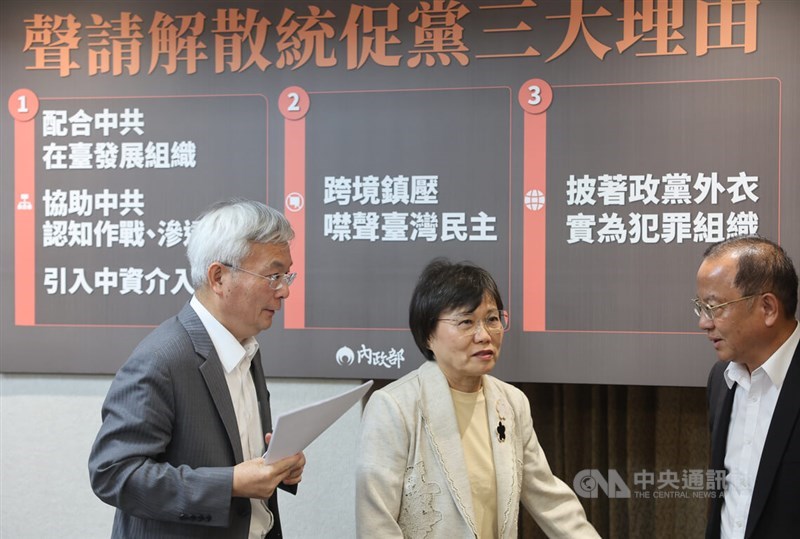
The ministry cited three grounds for seeking the party's dissolution: collaborating with China to establish organizations in Taiwan, carry out united front work, infiltrate grassroots groups, recruit military personnel for espionage and interfere in elections; engaging in cross-border repression, including attacks on Hong Kong activists and other pro-democracy figures in Taiwan; and operating as a criminal organization under the guise of a political party.
It also accused the CUPP of recruiting Chinese spouses for activities directed by Beijing, sponsoring trips to China to influence voters, organizing protests to disrupt election campaigns, operating radio programs that spread Chinese propaganda, and infiltrating civic groups and temple associations.
On cross-border repression, the ministry cited a 2019 attack in which red paint was thrown at Hong Kong singer-activist Denise Ho (何韻詩), a bloody clash at a "Sing! China" event at National Taiwan University, and the treatment of Hong Kong activist Joshua Wong (黃之鋒) during an airport confrontation in 2017.
Separately, MOI officials said authorities had identified 15 temples in seven cities and counties allegedly infiltrated by the CUPP as part of Beijing's united front efforts and would scrutinize their financial records.
Criminal Investigation Bureau Commissioner Chiu Shao-chou (邱紹洲) said police had investigated 98 organized crime cases linked to CUPP members since 2010, involving 141 suspects, including 32 core party cadres.
Asked whether the party could simply re-form under another name, Liu said any successor political party or organization would be handled under relevant laws.
The ministry added that members of a party dissolved by the Constitutional Court cannot establish a successor organization with the same objectives or a substantially similar name.
A national security official, speaking separately, said dissolving a political party for threatening national security and the democratic order would not be unprecedented internationally.
The official cited Spain's Batasuna party, which was dissolved after being widely regarded as the political wing of the Basque separatist group ETA, and South Korea's Unified Progressive Party, which was dissolved in 2014 after its Constitutional Court found that some cadres had plotted to sabotage infrastructure and discussed cooperating with North Korea in the event of war.
The planned petition follows the January 2025 resolution by the MOI's political parties review committee recommending the CUPP's dissolution.
Its submission was delayed because the Constitutional Court was unable to operate amid a deadlock over the appointment of new justices, until it resumed functioning in December 2025.
Founded in 2005 by Chang An-le (張安樂), better known as the "White Wolf," a former Bamboo Union triad leader, the CUPP advocates unification between Taiwan and China under Beijing's "one country, two systems" framework.
- Sports
Taiwan boosts medal haul in multiple events at Asian Games on Friday
10/02/2026 08:55 PM - Society
Workers at Taiwan snack maker Kuai Kuai extend strike over relocation
10/02/2026 08:45 PM - Business
Chain businesses association seeks more foreign workers
10/02/2026 08:04 PM - Politics
Shen unveils Taipei education platform, Chiang defends free lunches
10/02/2026 06:45 PM - Politics
Taiwan receives first 2 F-16V Block 70s (update)
10/02/2026 06:39 PM